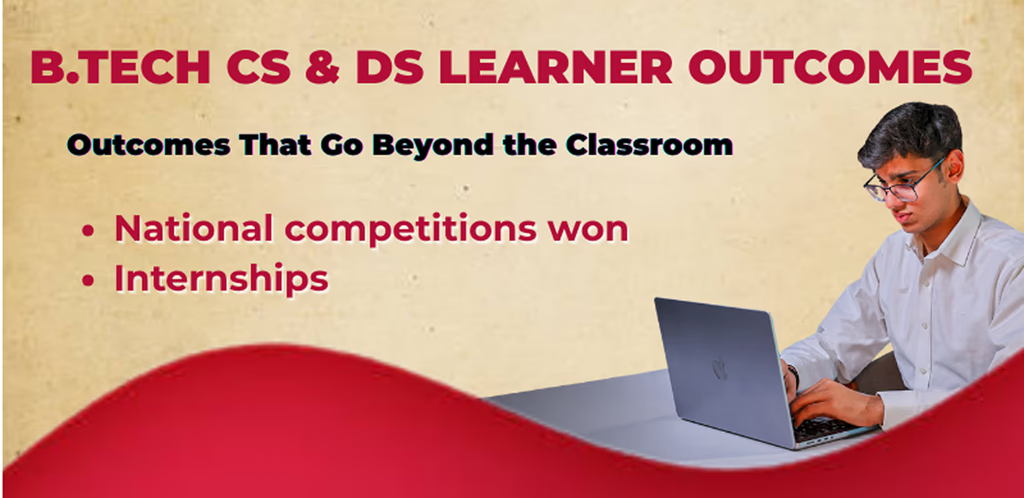
At Rishihood University, the success of our B.Tech in CS & DS program isn’t measured by grades alone. It shows up in what students build,
Blog
-
India’s Deep Tech Ambition: A Call for Innovation
Commerce Minister Piyush Goyal set the stage ablaze at Startup Mahakumbh 2025 (April,3rd) challenging India’s startup ecosystem to pivot from consumer-driven ventures like artisanal ice creams to transformative technologies like AI and semiconductor chips.
-
25 Fantastic Career Options in Artificial Intelligence for B.Tech Students
The blog lists 25 fantastic career options in artificial intelligence for B.Tech students in India who want to pursue engineering and CS AI.
-
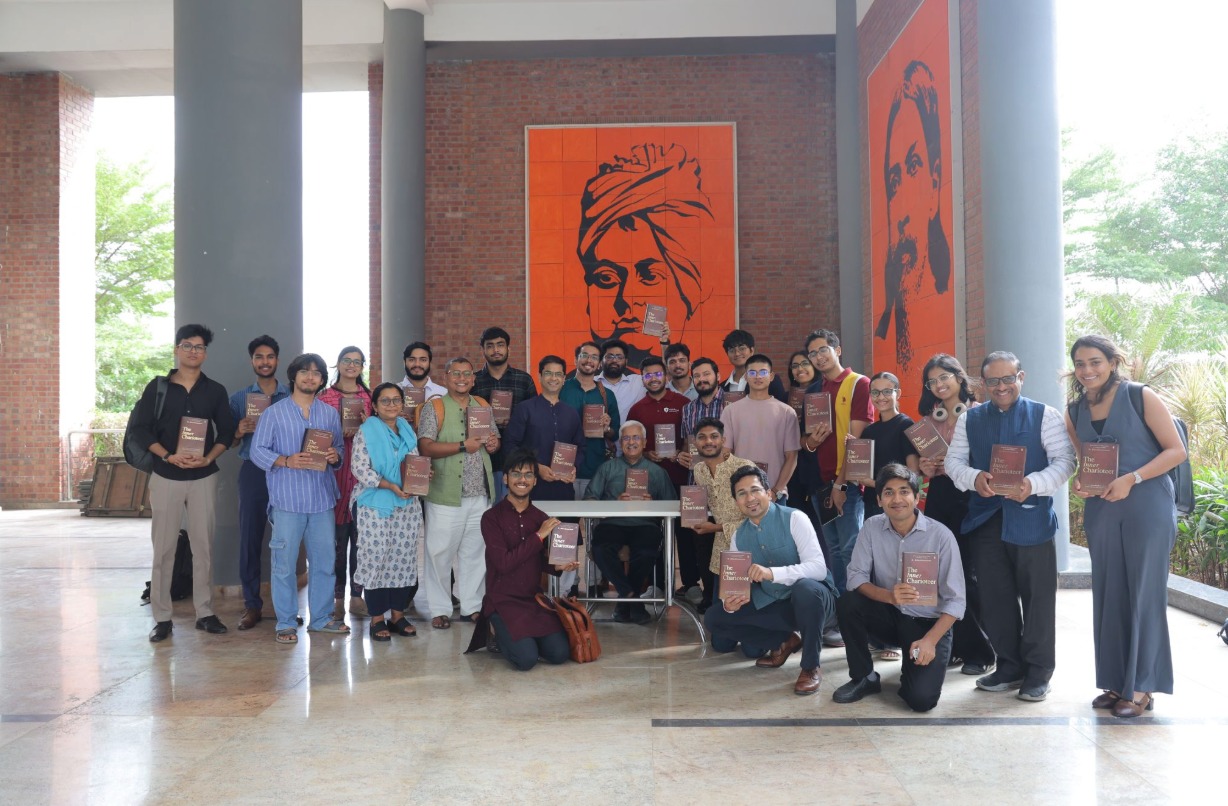
Leadership Lessons from Dr. Balu’s recent book launch at Rishihood University
Dr. R. Balasubramaniam is a former Frank H. T. Rhodes Professor at Cornell University, development practitioner, leadership educator, author, and public policy expert. He also serves as a full-time member of NITI Ayog.
- Lesson 1: Self-mastery is the foundation of leadership
- Lesson 2: Leadership is about responsibility, not recognition
- Lesson 3: Self-reflection is a practice, not a one-time exercise
- Lesson 4: Timeless wisdom can speak to a new generation
- Lesson 5: Education must develop people, not just professionals
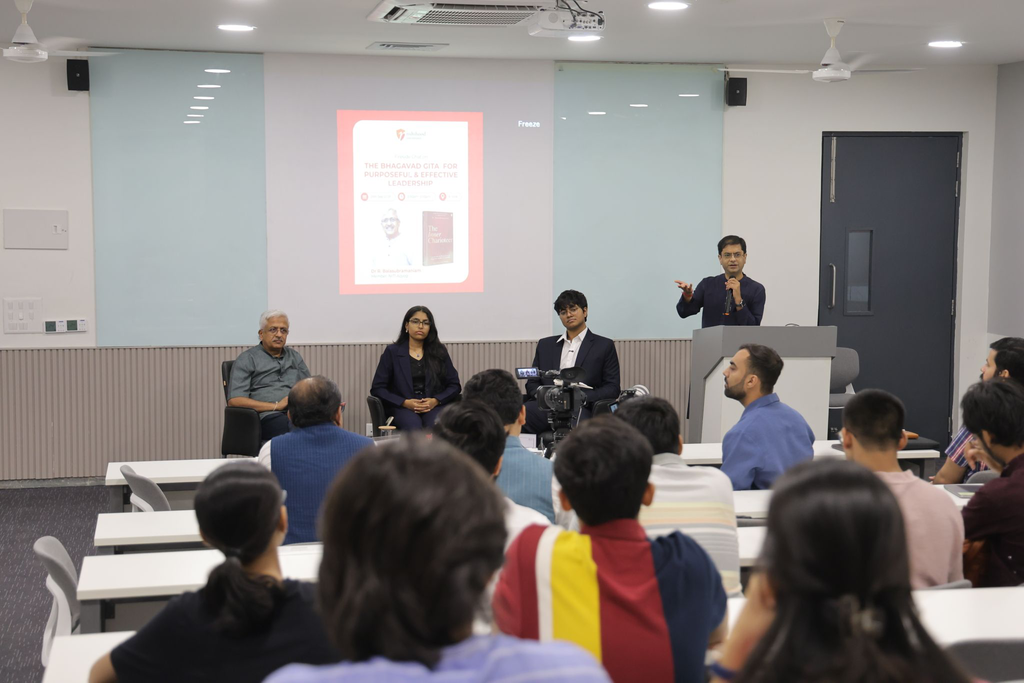
At the launch of his book, The Inner Charioteer, at Rishihood University, our learners, Ritesh and Tripti, sat down with Dr. Balu to explore leadership, self-mastery, and the wisdom of the Bhagavad Gita. The conversation offered valuable lessons on making better decisions, understanding oneself, and leading with purpose.
Here are five key takeaways from the conversation:
Lesson 1: Self-mastery is the foundation of leadership
Drawing on the Bhagavad Gita, Dr. Balu spoke about Indriya Vijaya, or mastery over the senses. It shows up in how we listen to others, respond to criticism, manage our emotions, and make decisions under pressure.
A leader who cannot guide their own thoughts and actions will struggle to guide others. Before asking whether a decision is popular or profitable, leaders must learn to ask whether it is right.
For anyone aspiring to lead teams, institutions, or communities, the starting point is the same: understand yourself before attempting to influence others.
Lesson 2: Leadership is about responsibility, not recognition
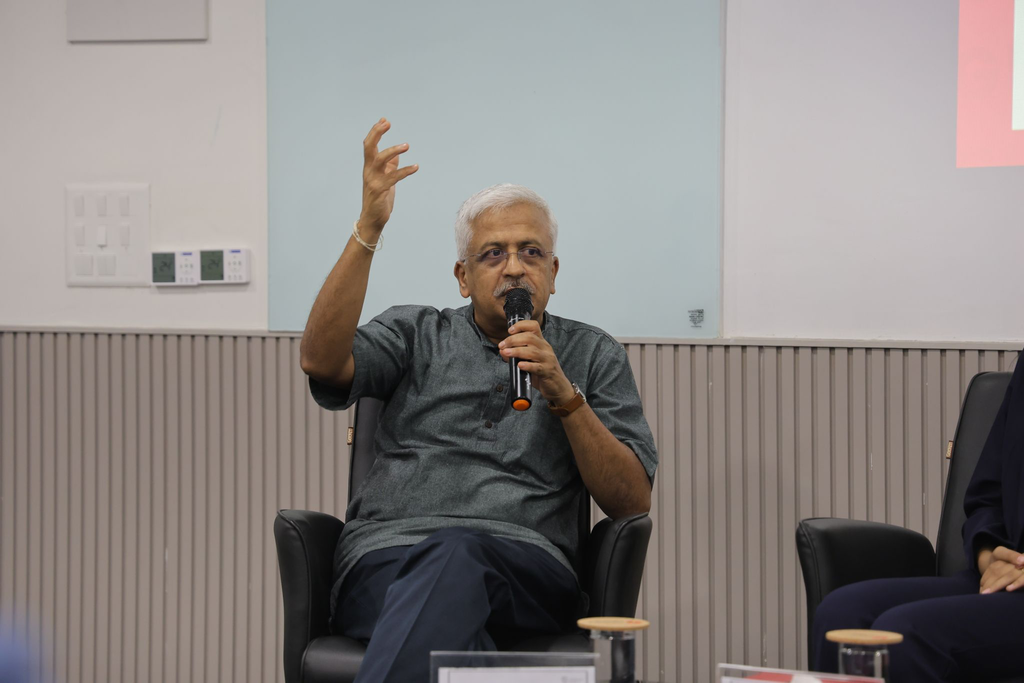
Dr. Balasubramanium also highlighted the concepts of Tyaga and Seva. People often see renunciation and service as ideas that are hard to fit into the pressures of modern life.
The way he sees them, they are quite practical. They ask people to take full responsibility for their work without letting ego, ambition or the need for a particular result drive them.
Lesson 3: Self-reflection is a practice, not a one-time exercise
One particularly important idea he shared with the learners was Sadhana i.e. The constant practice of self-reflection. Understanding oneself is not a one-time revelation but an ongoing process that requires patience and sustained practice.
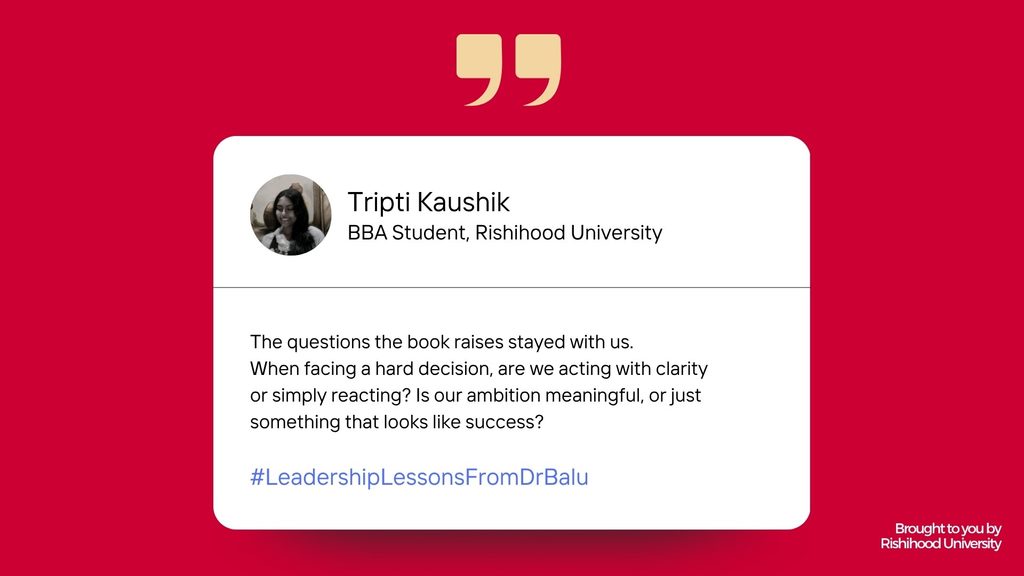
The questions the book raises stayed with the learners.
When facing a hard decision, are they acting with clarity or simply reacting?
Is their ambition meaningful, or just something that looks like success?The Bhagavad Gita may be centuries old, but the tension between what we ought to do and what we feel like doing remains deeply relevant. Self-reflection helps us recognise that tension and respond with greater clarity.
Lesson 4: Timeless wisdom can speak to a new generation
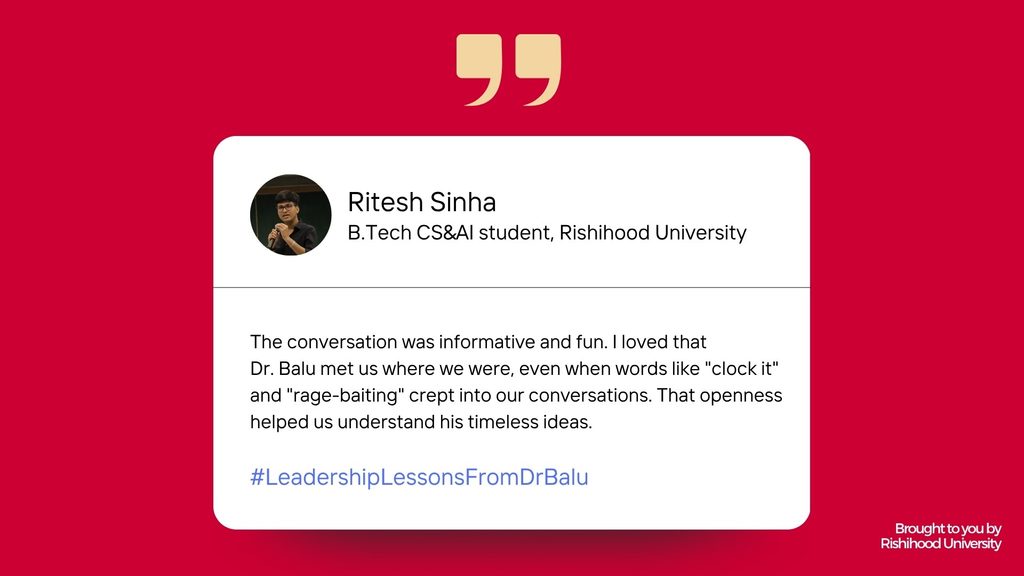
Dr. Balu connected with learners on their own terms, even as contemporary expressions such as “clock it” and “rage-baiting” found their way into the discussion. That openness proved that timeless ideas do not have to feel distant or inaccessible to younger generations.
The real question is not simply what the Bhagavad Gita teaches, but how its ideas can shape the way we live, work, make decisions, and lead.
By bringing ancient wisdom into conversation with contemporary experiences, Dr. Balu showed how philosophical ideas can become practical tools for navigating modern life.
Lesson 5: Education must develop people, not just professionals
The National Education Policy (NEP) 2020 emphasises holistic development, critical thinking, ethical reasoning, and the integration of Indian knowledge systems into education. It encourages institutions to look beyond academic qualifications and consider the individuals they are helping shape.
This is particularly relevant for learners preparing to take on responsibilities in business, technology, public policy, and society. Technical knowledge and professional skills matter. But so do judgement, self-awareness, empathy, and a sense of responsibility.
At Rishihood University, conversations like these create opportunities for learners to engage with ideas beyond the classroom and reflect on the kind of professionals and leaders they aspire to become.
The distinction between philosophical wisdom and everyday leadership becomes smaller when learners are encouraged to ask not just what they know, but how they will use that knowledge.
-
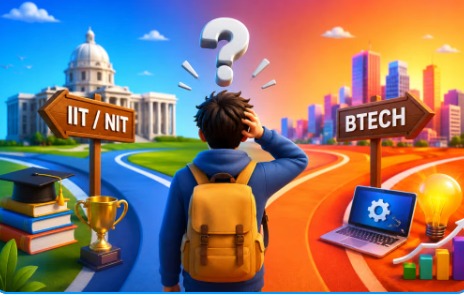
What If You Don’t Get IIT or NIT: Is Engineering BTech Still Worth It?
Is BTech worth it without IIT or NIT? Discover engineering ROI, AI hiring trends, salary growth, and CUET pathways for non-IIT engineers in India.
- Engineering remains one of India’s largest graduate employment pathways, even outside IITs and NITs.
- Engineering graduates recorded over 70% employability in recent national skills assessments, with Computer Science and IT leading the demand curve.
- Recruiters increasingly prioritize skills, internships, projects, GitHub portfolios, and problem-solving ability over college brand alone.
- Data Science, Cybersecurity, and Electronics continue to see strong industry demand.
- Multiple admission pathways exist beyond JEE ranks, including CUET-based admissions, private university entrance exams, and state counselling processes.
- Long-term career growth depends more on continuous skill development than the logo on a degree certificate.
Introduction
For years, students believed that getting into an IIT or NIT was the only path to a successful engineering career. But the job market is changing fast. Today, many exciting opportunities are available across different colleges, skills, and specializations.
If your JEE Main percentile wasn’t enough to secure admission to an IIT or NIT, it doesn’t mean you’ve failed. The real question is whether you can still build a successful career with a BTech from another college. The answer is yes, if you choose the right branch and develop strong skills.
The hiring environment in India is changing fast. Companies like Zepto, Razorpay, Groww, and hundreds of SaaS startups now hire based on GitHub profiles, internship records, and problem-solving ability — not just institution names. A BTech from a well-chosen private university, backed by real projects and certifications, can compete for the same roles.
This article will help you make that decision clearly, without motivational fluff, and with India-specific data.
Why IIT and NIT Are Not the Only Engineering Colleges in India
When students think about engineering, the focus is often on IITs and NITs. But these colleges represent only a small part of India’s engineering education system.
India has thousands of AICTE-approved engineering colleges, including private universities, deemed universities, and state engineering colleges. Several private institutions, like Rishihood University, have built strong industry connections and offer modern programs in areas like Artificial Intelligence, Data Science, Cybersecurity, and Software Development.
Colleges such as BITS Pilani, VIT, Manipal, SRM, and Thapar have produced graduates who work at leading companies and fast-growing startups. Many of these colleges provide industry-focused courses, internships, and practical learning opportunities that help students prepare for jobs.
State engineering colleges can also be a good choice, especially for students who actively build their skills through projects, certifications, internships, and online learning.
Here is the reality of India’s engineering ecosystem in 2026:
College Type Number of Institutes Approximate Seats Admission Route IITs 23 ~17,000 JEE Advanced NITs 31 ~23,000 JEE Main (JoSAA) IIITs 26 ~7,500 JEE Main (JoSAA) State Engineering Colleges 1,000+ ~6 lakh State CETs Private Universities (AICTE approved) 3,000+ ~18 lakh Direct/RSAT/CUET/Own Entrance Explore B.Tech at Rishihood University — No JEE required. Apply through RSAT and a personal interview. Apply Now What Recruiters Look for Beyond IIT and NIT Tags?
A college brand can help you get noticed, but cannot replace technical competence.
A large number of India’s fastest-growing companies have moved beyond college reputation and are focusing more on what candidates can do.
A 2023 LinkedIn Talent Insights report noted that skills-based hiring grew by over 60% among Indian tech employers in two years. Startups, SaaS companies, and product firms evaluate candidates on a very different checklist:
- Coding ability: demonstrated through platforms like LeetCode, Codeforces, or HackerRank
- GitHub profile: active repositories, open-source contributions, personal projects
- Internship experience: real-world problem exposure, even from early semesters
- Relevant certifications: AWS, Google Cloud, TensorFlow, or data engineering credentials
- Communication and problem-solving: increasingly tested in take-home assignments and system design rounds
One young engineer from a tier-3 college in India doubled his salary from ₹12 LPA to ₹24 LPA in less than two years, without frequent job-hopping. His secret? He didn’t wait for campus placements. He joined a startup as an intern midway through his third year, earned a ₹25,000 monthly stipend, and eventually converted to a full-time role at ₹12 LPA.
A popular discussion on Reddit summed it up well: one software engineer said that their startup never asked which college they attended. Instead, the interview focused on coding skills, system design knowledge, and projects on GitHub.
The focus has shifted from where students study to what they can do. This change is happening because India produces a huge number of engineering graduates every year, and employers cannot judge candidates based on the names of thousands of colleges alone.
This is precisely what Rishihood University’s BTech program is structured around. From semester one, students build real projects, work with industry mentors, and develop portfolios that speak directly to what modern recruiters evaluate. No waiting until final year to start. See how Rishihood prepares engineers for the real world.
BTech Artificial Intelligence and Emerging Engineering Careers in India
One of the biggest reasons engineering remains relevant in 2026 is the rapid growth of AI-driven industries.
India is becoming a major hub for Artificial Intelligence, machine learning, automation, and data-driven innovation. From healthcare and finance to manufacturing, logistics, and education, organizations are investing heavily in AI-powered products and services.
AI engineering hiring in India grew 59.5% year-on-year, which is the highest growth rate among the US, UK, France, and Germany.
Role Average Starting Salary (India, 2026) Key Skill Stack ML Engineer ₹8–14 LPA Python, TensorFlow, PyTorch Data Scientist ₹7–12 LPA SQL, ML, Statistics AI Product Engineer ₹9–16 LPA LLMs, APIs, RAG pipelines MLOps Engineer ₹10–18 LPA Docker, Kubernetes, CI/CD NLP Engineer ₹10–15 LPA Transformers, Hugging Face None of the above roles require an IIT degree. The common requirement is practical experience, whether through projects, internships, hackathons, or industry collaborations.
Rishihood University’s B.Tech CS & AI program, offered under the Rishihood-Newton School of Technology partnership, is built around exactly this demand. The curriculum integrates applied AI, real-world project tracks, and mentorship from 100+ CXOs, with a 93% second-year paid internship rate.
Engineering Specialization and College Type
A common mistake students make after JEE results is focusing entirely on the college name while ignoring the branch or specialization they are choosing.
In reality, your specialization often has a greater impact on career opportunities than whether you studied at an IIT, private university, or state engineering college.
Here is where hiring demand is strongest right now:
Specialisation Key Roles Top Hiring Sectors BTech Computer Science Software Engineer, Backend Dev, SDE Product, SaaS, Fintech BTech Artificial Intelligence ML Engineer, AI Researcher, Data Scientist AI startups, Enterprise Tech BTech Data Science / Analytics Data Analyst, BI Engineer, Analytics Lead E-commerce, Banking, Consulting BTech Cybersecurity Security Analyst, Ethical Hacker, Cloud Security BFSI, Defence, IT Services BTech Electronics Embedded Engineer, VLSI Designer, IoT Developer Semiconductor, EV, Hardware BTech Business Analytics Product Analyst, Strategy Analyst SaaS, Consulting, D2C Now the harder question: which type of institution actually delivers on these specializations?
IIT vs Private Universities vs State Engineering Colleges
Factor IIT/NIT Leading Private Universities State Engineering Colleges Brand Recognition Excellent Strong Moderate Industry Exposure Strong Often Strong Varies Faculty & Research Excellent Improving Rapidly Varies Infrastructure Excellent Often Modern Varies Fees Moderate to High High Lower Student Diversity High High Moderate Entrepreneurial Ecosystem Strong Growing Fast Limited The key takeaway is simple: A good private university, like Rishihood University, with a strong BTech Computer Science or BTech Artificial Intelligence program can open doors to many of the same roles and employers that recruit from NITs. In today’s job market, skills, projects, and practical experience often matter as much as the name of the college.
What If Your JEE Percentile Is Lower Than Expected?
A low JEE Main percentile does not close the door on engineering, but simply redirects it.
India’s BTech admission process offers multiple pathways that many students and parents are unaware of, largely because coaching centre discussions rarely go beyond JEE rank lists.
Here are the realistic routes available after Class 12:
Admission Route Who It’s For Key Details JEE Main State Counselling 40–75 percentile range Access to state government engineering colleges via centralized counselling CUET (Common University Entrance Test) Students targeting central universities Separate from JEE; covers universities like Delhi University engineering programs Private University Entrance Exams RSAT, VITEEE, SRMJEEE, MET, UPES DAT Independent exams with lower cutoffs; merit-based scholarships available Direct Admission Management quota or merit-based Available at many private colleges; fees vary significantly Lateral Entry Diploma holders Direct entry into second year BTech Many private universities conduct their own entrance exams for programs like BTech Artificial Intelligence and BTech Computer Science. This gives students another pathway to admission, even if their JEE score is lower than expected.
Ultimately, your career trajectory depends more on the skills and experiences you build during college than on your entrance exam score.
Rishihood University offers BTech admissions through a straightforward process designed for motivated students, regardless of JEE percentile. Check eligibility and apply here. B Tech Admission in India After Class 12: Understand Your Options
There are many ways to get into an engineering college. The important question is: which one should you choose?
If you scored above 93 percentile in JEE Main
- You are eligible for JEE Advanced, so you should attempt it.
- If you secure a good rank and get Computer Science or Electronics at an IIT, that is usually the best option.
- If not, you can participate in JoSAA counselling for NITs and IIITs.
- Keep in mind that Computer Science seats at the top NITs are highly competitive and usually close at very high ranks.
If you scored between 70 and 93 percentile in JEE
- You may get seats in newer NITs or IIITs through JoSAA counselling.
- You should also apply for exams like BITSAT, VITEEE, and SRMJEEE.
- If your state has an engineering entrance exam, apply for that as well. Examples include MHT CET, WBJEE, and KCET.
Scored below 70 percentile or did not take JEE
- Private university entrance exams are likely to be your best option.
- Most universities require at least 60% marks in Class 12 with Physics, Chemistry, and Mathematics.
- Many private universities do not require a JEE score.
- For example, Rishihood University admits students through RSAT, an aptitude test that focuses on problem-solving and analytical thinking, followed by a personal interview.
One rule applies to everyone
Many private university applications open early. If you wait for JEE results before applying, you may miss out on scholarships, preferred programs, and admission opportunities.
Seats are limited. Apply today to lock your preferred branch. How Non-IIT Engineers Build High-Growth Careers?
In today’s job market, internships, projects, GitHub portfolios, and certifications have become a key part of the real BTech learning experience.
Imagine two students graduating with the same BTech degree. One studied at an IIT. The other studied at a private university.
The IIT student has good grades. The private university student has completed two internships, built projects on GitHub, and earned an AWS certification.
Who gets the job?
The answer is obvious. That is because employers are looking at more than just college names. They want proof of skills.
The students who get ahead usually focus on five things from the start of college:
Activity Why It Matters Where to Show It Internships (paid preferred) Proof of professional functioning Resume, LinkedIn GitHub (consistent commits) Verifiable coding history GitHub profile link Deployed projects Evidence of end-to-end execution Portfolio / GitHub Hackathons Problem-solving under pressure Resume, LinkedIn Industry certifications Skill credibility (AWS, Google, NPTEL) LinkedIn, Resume Certification-backed skills increase readiness for internships and can lead to pre-placement offers, helping Tier 2 students better compete with their Tier 1 peers. The four years of a BTech program are long enough to build a body of work that outweighs the college name on your resume, but only if you start in semester one, not semester seven.
At Rishihood, internship placement is structured, not left to chance. 93% of students are placed in paid internships by Year 2. Learn about Rishihood’s industry integration program.
When Engineering BTech May Not Be the Right Choice?
Engineering can lead to exciting careers, but it is not the right choice for everyone.
Don’t choose engineering just because your friends are choosing it, your family expects it, or you believe it guarantees a high-paying job.
A career in engineering requires curiosity, problem-solving skills, and a willingness to keep learning throughout your life. Technology changes quickly, and engineers need to keep up.
If you are more interested in fields like design, law, business, entrepreneurship, media, healthcare, or the humanities, it is perfectly okay to explore those paths instead.
The best career choice is not the most popular one. It is the one that matches your interests, strengths, and goals.
Choose engineering because you genuinely want to build, solve, and create, not because everyone else is doing it.
How to Decide Whether to Pursue BTech After JEE Results
Before making a decision, shift your focus away from the exam result and toward your long-term goals.
Ask yourself:
- Do I enjoy solving technical problems?
- Am I interested in technology, innovation, or building products?
- Which engineering specializations excite me the most?
- Can the college I am considering provide meaningful industry exposure?
- Will this degree help me build skills that remain relevant over the next decade?
Remember that a JEE score is a snapshot of performance on a particular set of exams. It is not a measure of your potential as an engineer.
Many successful professionals started their journeys at colleges that never appeared in national headlines. What set them apart was their commitment to learning, building, experimenting, and continuously improving.
If you are excited by technology and willing to invest in developing valuable skills, a B.TECH Engineering without IIT can still be a powerful pathway to a rewarding and future-ready career.
Your Career Will Be Defined by Skills, Not a College Name
Not getting into an IIT or NIT can feel disappointing. But it is only one step in a much longer journey.
Today’s technology industry offers opportunities in AI, cybersecurity, software development, data science, cloud computing, and many other fields. Employers are looking for people who can solve problems, build projects, and learn new skills—not just people from well-known colleges.
What matters most is finding a college where you can learn, grow, and gain real-world experience.
At Rishihood University, students learn through hands-on projects, industry exposure, mentorship, and emerging technologies such as AI. The goal is not just to earn a degree, but to build the skills needed for future careers.
As you explore engineering options after Class 12, look beyond rankings and exam results. Because in the years ahead, success will depend less on the name of your college and more on what you can do with what you learn.
Explore how Rishihood University’s industry-led BTech programs can help you build future-ready skills in AI, Computer Science, and emerging technologies. Schedule a campus visit or speak with an admissions advisor today.
FAQs
Is a BTech worth it if I don’t get into an IIT or NIT?
Yes. Many engineers build successful careers through private universities, state colleges, and alternative admission pathways. Skills, internships, and projects often matter more than college brand in the long run.
Which BTech specialization has the best career prospects in 2026?
Computer Science, Artificial Intelligence, Data Science, Cybersecurity, and Electronics are among the most in-demand engineering fields due to strong hiring across technology, AI, and product companies.
Can I get BTech admission without a high JEE score?
Yes. Students can pursue engineering through state counselling, CUET-based admissions, private university entrance exams, and direct admission routes offered by eligible institutions.
Do companies hire engineers from non-IIT colleges?
Absolutely. Most recruiters evaluate candidates based on technical skills, internships, projects, certifications, and problem-solving ability rather than college name alone.
-
Specializations in a B.Sc Psychology Degree in India: Career Scope, Subjects & Future Opportunities
The article explains various high-paying specialisations in a B.Sc Psychology Career for students in India. It also the best psychology colleges in Delhi NCR
India’s focus on mental health has increased significantly over the past few years. The National Mental Health Survey estimated that nearly 14% of India’s population experiences some form of mental health concern during their lifetime, while the World Health Organization continues to highlight the growing burden of mental disorders worldwide. Alongside this shift, schools, hospitals, rehabilitation centres, corporate organisations, startups, and wellness platforms have expanded their demand for psychology professionals.
The growing awareness has also made B.Sc Psychology one of the popular psychology courses after 12th for students interested in healthcare, human behaviour, counselling, and research. However, many students discover that psychology offers multiple career paths beyond traditional therapy. Clinical psychology, counselling psychology, industrial psychology, forensic psychology, sports psychology, educational psychology, and applied psychology each require different skill sets and lead to distinct employment opportunities.
The rapid growth of teletherapy platforms, corporate wellness programmes, educational counselling services, and rehabilitation facilities has further diversified career options for psychology graduates in India.
Choosing the right specialization can influence postgraduate education requirements, licensing pathways, salary potential, and long-term career growth. Understanding these differences helps students align their interests with industry demand.
This guide explains the major specializations available in a B.Sc Psychology degree in India, their subjects, career opportunities, salary expectations, and future prospects.
What Is a B.Sc Psychology Degree in India?
A B.Sc in Psychology is a three-year undergraduate programme that studies human behaviour, cognition, emotions, personality, learning processes, and mental health through scientific methods.
Students who have completed Class 12 from a recognised board can apply, although eligibility criteria vary across universities. Some institutions offer entrance examinations, while others provide admission based on merit.
Core B.Sc Psychology Subjects
Common B.Sc Psychology subjects include:
- Introduction to Psychology
- Biological Psychology
- Cognitive Psychology
- Developmental Psychology
- Social Psychology
- Experimental Psychology
- Psychological Testing
- Statistics and Research Methods
- Abnormal Psychology
- Counselling Psychology
- Organizational Behaviour
Many universities also include practical laboratory sessions, internships, case studies, research projects, and field visits.
B.Sc Psychology vs BA Psychology
B.Sc Psychology BA Psychology Science-oriented curriculum Arts-oriented curriculum Greater emphasis on research and statistics Greater emphasis on theory Laboratory work included Limited practical exposure Better preparation for clinical research Suitable for social sciences Many institutions also offer B.Sc Psychology Honours, which provides additional research training and advanced coursework.
Graduates often pursue higher studies such as:
- M.Sc Psychology
- MA Psychology
- M.Phil Clinical Psychology
- Rehabilitation Psychology
- Organisational Behaviour
- Neuropsychology
- Applied Psychology
Why Psychology Specializations Matter in India
A psychology degree provides foundational knowledge, but specialization determines career direction.
Different sectors require different expertise.
Clinical pathway
Works with mental health disorders and healthcare institutions.
Counselling pathway
Focuses on emotional well-being and behavioural support.
Industrial pathway
Addresses workplace productivity and employee engagement.
Educational pathway
Supports learning and child development.
Forensic pathway
Combines psychology with legal systems.
Sports pathway
Improves athlete performance and resilience.
Specialization also affects postgraduate requirements.
For example:
Specialization Higher Education Requirement Clinical Psychology RCI-approved postgraduate training Counselling Psychology Master’s preferred Industrial Psychology MBA HR or M.Sc beneficial Educational Psychology M.Ed or M.Sc Sports Psychology Specialized postgraduate study Industry demand differs significantly. Corporate wellness companies may recruit industrial psychologists, while hospitals seek clinical and rehabilitation specialists.
Choosing a specialization early allows students to plan internships, certifications, and postgraduate education strategically.
Watch Sneha – B.Sc Psychology student talk about exploring research as a career during her undergraduate journey. Clinical Psychology Specialization in India
Clinical psychology focuses on identifying, assessing, and treating mental health disorders.
Clinical psychologists work with patients experiencing:
- Anxiety disorders
- Depression
- Trauma
- OCD
- Personality disorders
- Addiction
- Childhood behavioural disorders
Workplaces
Clinical psychologists may work in:
- Government hospitals
- Private hospitals
- Rehabilitation centres
- Psychiatric clinics
- NGOs
- Mental health institutes
Licensing Requirements
A B.Sc Psychology degree alone does not qualify graduates for independent clinical practice.
Students generally pursue:
- Master’s degree
- RCI-recognised professional training
- Clinical internships
Current regulatory requirements should always be verified through recognised authorities before planning a career path.
Key Subjects
- Abnormal Psychology
- Psychopathology
- Clinical Assessment
- Psychological Testing
- Psychotherapy
- Neuropsychology
Salary Potential
Experience Average Annual Salary Entry-level ₹3–5 lakh Mid-level ₹6–10 lakh Experienced ₹12–20 lakh+ Private practice can increase earnings depending on experience and location.
Career Opportunities
- Clinical Psychologist
- Rehabilitation Specialist
- Mental Health Consultant
- Hospital Counsellor
- Research Associate
Metro cities including Delhi, Mumbai, Bengaluru, Hyderabad, and Pune continue expanding mental healthcare infrastructure, creating growing demand for qualified psychology professionals. Institutions such as Rishihood University support learners in building industry-relevant skills through experiential learning, research exposure, supervised practice, and interdisciplinary collaboration, helping graduates prepare for careers across healthcare, education, research, and mental wellness sectors
Explore a Psychology Program that combines academic learning with real-world internships and career support Counseling Psychology Careers in India
Counselling psychology helps individuals manage emotional, social, educational, and personal challenges.
Unlike clinical psychology, counselling often addresses adjustment issues and life transitions rather than severe psychiatric disorders.
Most psychology programmes are open to students from Arts, Science, and Commerce backgrounds, with admission based on merit, entrance examinations, or university-specific criteria.
Hear from Divya – B.Sc Hons student at Rishihood University on why she chose B.Sc Psychology instead of BA Employment Areas
- Schools
- Colleges
- Universities
- NGOs
- Family counselling centres
- Wellness organisations
- Online therapy platforms
Counselling psychologists may work with:
- Students
- Couples
- Families
- Working professionals
- Elderly populations
Urban Demand
Large Indian cities have witnessed increased demand for counselling services after 2020 and educational institutions increasingly employ counsellors to support student well-being.
Corporate organisations also integrate counselling into employee assistance programmes.
Salary Range
Experience Annual Salary Fresher ₹3–5 lakh Mid-level ₹5–8 lakh Experienced ₹10–15 lakh Private consultations and digital platforms can create additional income streams.
Industrial and Organizational Psychology Scope in India
Industrial and organizational psychology applies behavioural science to workplaces.
Its primary goal involves improving employee satisfaction, organisational effectiveness, and workplace productivity.
Major Functions
- Recruitment assessment
- Employee engagement
- Leadership development
- Performance evaluation
- Training programmes
- Conflict management
Corporate Wellness
Indian organisations increasingly invest in:
- Stress management
- Burnout prevention
- Employee mental health
- Leadership coaching
Employment Sectors
- IT companies
- MNCs
- Startups
- Consulting firms
- Manufacturing
- Healthcare organisations
Salary Potential
Experience Annual Salary Entry-level ₹4–7 lakh Mid-level ₹8–15 lakh Senior ₹18–30 lakh Industrial psychology also complements careers in HR and organisational consulting.
Forensic Psychology Careers in India
Forensic psychology combines psychology with criminal justice.
Professionals analyse behavioural patterns that support investigations and rehabilitation.
Work Areas
- Criminal profiling
- Witness assessment
- Prison rehabilitation
- Juvenile justice
- Victim support
- Legal consultation
Employment Opportunities
- Government agencies
- Correctional facilities
- NGOs
- Research institutions
- Academic organisations
Key Subjects
- Criminal Behaviour
- Legal Psychology
- Forensic Assessment
- Victimology
- Rehabilitation Psychology
Salary
Annual salaries generally range between ₹4–10 lakh, depending on qualifications and experience.
Higher studies significantly improve opportunities.
Sports Psychology Opportunities in India
Sports psychology focuses on mental performance and athlete well-being.
Growing professional leagues have increased awareness about psychological training.
Responsibilities
- Motivation building
- Stress management
- Performance anxiety reduction
- Goal setting
- Team communication
Employers
- Sports academies
- Professional teams
- Fitness organisations
- Olympic training centres
- Educational institutions
Salary
Entry-level professionals earn approximately ₹4–6 lakh annually, while experienced consultants working with elite athletes can earn substantially more.
Educational Psychology Careers in India
Educational psychology studies learning processes and student development.
Professionals help improve academic outcomes and emotional well-being.
Career Areas
- Schools
- Special education centres
- Educational NGOs
- Curriculum development
- Child guidance clinics
Responsibilities
- Learning assessments
- Behavioural interventions
- Student counselling
- Teacher training
- Inclusive education planning
Growing awareness of student mental health has encouraged many educational institutions to strengthen counselling and support services.
Salary
Average annual salaries range from ₹3–8 lakh depending on experience and organisation. Programmes such as the B.Sc. (Hons.) Psychology at Rishihood University combines psychology with research, neuroscience, behavioural science, internships, and experiential learning opportunities, helping students connect theory with real-world application from an early stage.
Applied Psychology Courses and Career Scope
Applied psychology uses psychological principles to solve practical problems in healthcare, education, business, community development, and public policy. Unlike specializations that focus on a single field, applied psychology integrates multiple branches to improve individual and social outcomes.
Major Areas of Application
Applied psychologists work in:
- Hospitals and healthcare organizations
- Community mental health programmes
- NGOs and social welfare agencies
- Educational institutions
- Corporate organizations
- Government departments
- Research centres
Their responsibilities may include behavioural assessments, programme evaluation, crisis intervention, community outreach, and policy development.
Career Opportunities
Popular roles include:
- Behavioural Analyst
- Community Counsellor
- Rehabilitation Coordinator
- Research Assistant
- Public Health Consultant
- Social Development Officer
The increasing focus on preventive healthcare and community wellness has expanded opportunities for psychology graduates in India.
Salary Range
Experience Annual Salary Entry-level ₹3–5 lakh Mid-level ₹6–9 lakh Experienced ₹10–15 lakh Students interested in social impact, healthcare delivery, and multidisciplinary work often choose applied psychology.
Psychology Specializations With Highest Salary Potential in India
Salary depends on specialization, qualifications, location, experience, and whether professionals work independently or within organizations.
Salary Comparison Table
Specialization Entry Level Experienced Industrial Psychology ₹4–7 lakh ₹18–30 lakh Clinical Psychology ₹3–5 lakh ₹12–20 lakh+ Counseling Psychology ₹3–5 lakh ₹10–15 lakh Forensic Psychology ₹4–6 lakh ₹10–15 lakh Sports Psychology ₹4–6 lakh ₹15 lakh+ Educational Psychology ₹3–5 lakh ₹8–12 lakh Applied Psychology ₹3–5 lakh ₹10–15 lakh Psychology professionals working in Delhi NCR, Mumbai, Bengaluru, Hyderabad, Chennai, and Pune often receive higher compensation due to greater demand and larger healthcare and corporate ecosystems.
Corporate vs Clinical Careers
Corporate Clinical Higher starting salaries Longer education pathway HR and wellness roles Hospital and private practice Leadership consulting Therapy and assessments Organizational development Mental healthcare Private Practice and Freelancing
Experienced psychologists can supplement their income through:
- Private consultations
- Corporate workshops
- Online counselling
- Training programmes
- Academic teaching
- Mental health content development
Higher education and specialized certifications significantly improve earning potential.
Best Psychology Colleges and Universities in India
Selecting the right institution affects research exposure, internships, postgraduate opportunities, and placements.
Rishihood University: An Emerging Choice for Psychology
Rishihood University is gaining attention for its B.Sc. (Hons.) Psychology programme, which combines traditional psychology with interdisciplinary learning and practical experience. The curriculum covers core areas of psychology while introducing students to fields such as neuroscience, Indian psychology, and behavioural science.
A key strength of the programme is its focus on hands-on learning. Students gain practical exposure through specialised psychology labs, research projects, internships, and community-based initiatives. The university also encourages interdisciplinary learning by offering opportunities to explore subjects like AI, entrepreneurship, and public policy alongside psychology.
The programme is designed to build research, analytical, and critical thinking skills, making it suitable for students interested in higher studies as well as careers in counselling, organisational behaviour, behavioural research, education, and social impact sectors.
While many established universities offer strong psychology programmes, Rishihood stands out for its research-driven and experiential approach to undergraduate education. For students seeking a modern curriculum that balances academic knowledge with practical application, it is an emerging option worth considering.
NIMHANS
The National Institute of Mental Health and Neurosciences is recognised for advanced mental health education and research.
Strengths:
- Clinical exposure
- Research facilities
- Hospital training
- Mental health specialization
Delhi University
Several colleges under Delhi University offer strong psychology programmes with experienced faculty and active research initiatives.
Ambedkar University Delhi
Known for interdisciplinary learning and practical psychology education.
Christ University
Offers structured undergraduate and postgraduate psychology programmes with internship opportunities.
Tata Institute of Social Sciences (TISS)
Integrates psychology with public policy, healthcare, and social development.
Other Notable Psychology Colleges in India
- Banaras Hindu University
- Fergusson College
- Jamia Millia Islamia
- University of Calcutta
- Amity University
Factors to Compare
Students should evaluate:
- Faculty qualifications
- Research opportunities
- Laboratory facilities
- Internship exposure
- Placement support
- Industry collaborations
- Higher education pathways
Choosing a college based only on rankings may overlook programme quality and specialization strengths.
Skills Required for Psychology Careers in India
Academic knowledge alone does not guarantee success in psychology careers.
Students pursuing a B.Sc Psychology degree should develop both technical and interpersonal skills.
Essential Skills
Communication
Psychologists must explain complex concepts clearly and interact effectively with diverse populations.
Empathy
Understanding emotions and perspectives helps build professional relationships.
Observation
Behavioural analysis requires careful attention to verbal and non-verbal cues.
Research Skills
Many psychology careers involve data collection, analysis, and evidence-based decision making.
Ethical Practice
Maintaining confidentiality and professional standards is fundamental.
Emotional Intelligence
Managing one’s own emotions while supporting others improves professional effectiveness.
Data Interpretation
Modern psychology increasingly uses assessments, surveys, and statistical analysis.
Developing these skills during undergraduate education strengthens employability across multiple sectors.
Psychology Career Trends in India for 2026
The psychology profession continues evolving as technology, healthcare, and workplace practices change.
Teletherapy Expansion
Digital consultation platforms have increased access to psychological services across urban and semi-urban India.
Online counselling creates opportunities for qualified professionals to work remotely.
Corporate Wellness Growth
Organizations increasingly invest in:
- Employee assistance programmes
- Burnout prevention
- Mental health workshops
- Leadership coaching
Industrial and counselling psychologists benefit from this trend.
Mental Health Startups
India’s health technology ecosystem has encouraged the growth of digital mental health platforms offering therapy, assessments, and wellness solutions.
AI-Assisted Mental Healthcare
Artificial intelligence supports:
- Preliminary screening
- Behaviour tracking
- Digital assessments
- Therapy management systems
AI complements rather than replaces trained psychologists.
Educational Institutions
Schools and universities increasingly recognise the need for:
- Student counsellors
- Career guidance experts
- Learning specialists
- Behavioural consultants
Rehabilitation Services
Growing awareness of developmental disorders, addiction recovery, and geriatric care has expanded rehabilitation opportunities.
Career Mapping Framework
Interest Recommended Specialization Mental healthcare Clinical Psychology Student wellness Counseling Psychology Business and HR Industrial Psychology Law and justice Forensic Psychology Sports performance Sports Psychology Child development Educational Psychology Community programmes Applied Psychology Students can use this framework to align academic interests with career objectives.
Who Should Choose a B.Sc Psychology Degree in India?
A B.Sc Psychology degree suits students interested in understanding human behaviour through scientific study.
It may be an appropriate choice for students who:
- Enjoy biology and social sciences.
- Want careers in healthcare or counselling.
- Have strong analytical abilities.
- Like research and data interpretation.
- Want to work in education or corporate sectors.
- Are interested in rehabilitation and community service.
The programme also benefits students planning higher studies in:
- Clinical Psychology
- Counselling Psychology
- Neuropsychology
- Organizational Behaviour
- Child Psychology
- Public Health
- Behavioural Science
Students should recognise that some psychology careers require postgraduate qualifications and professional licensing.
A B.Sc Psychology degree provides the academic foundation for these advanced pathways.
Frequently Asked Questions
Which psychology specialization has the highest salary in India?
Industrial and organizational psychology often offers some of the highest salaries, particularly in large corporations and consulting firms. Experienced clinical psychologists with successful private practices may also earn competitive incomes.
Is clinical psychology a good career in India?
Yes. Growing awareness of mental health and expanding healthcare infrastructure have increased demand for qualified clinical psychology professionals. Advanced education and regulatory requirements should be considered.
Can B.Sc Psychology students work in HR?
Yes. Many graduates pursue careers in human resources, recruitment, talent management, employee engagement, and organizational development. Additional certifications may improve opportunities.
Which colleges are best for psychology in India?
Leading institutions include NIMHANS, Delhi University, Ambedkar University Delhi, Christ University, TISS, Banaras Hindu University, and Jamia Millia Islamia.
Is psychology a high-demand career in India?
Demand continues expanding across healthcare, education, corporate wellness, rehabilitation services, digital mental health platforms, and community development programmes.
A B.Sc Psychology degree offers career opportunities across healthcare, education, business, law, sports, and technology. Beyond counselling, graduates can specialise in clinical, organisational, educational, forensic, or sports psychology based on their interests and career goals.
The field increasingly values practical skills alongside academic knowledge. Internships, research experience, digital literacy, and postgraduate qualifications can improve career prospects, while emerging areas like teletherapy, corporate wellness, educational counselling, and behavioural technology continue to expand opportunities.
When choosing a specialisation or college, focus on long-term growth, higher education pathways, and personal interests rather than salary alone. Compare factors such as curriculum, faculty, internship opportunities, research facilities, and placement support. A strong B.Sc Psychology programme can build the foundation for rewarding careers in mental healthcare, education, research, corporate wellness, and India’s growing digital mental health sector.
-
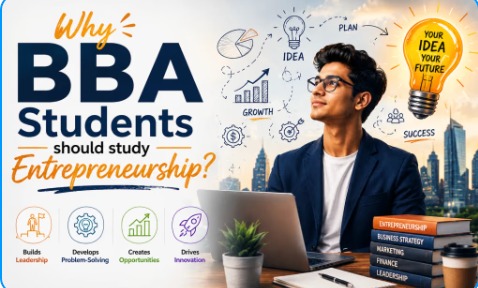
Why BBA Students should study entrepreneurship
A BBA in entrepreneurship helps students develop solution oriented mindset through practical learning, business simulations, and exposure to real-world.
- A BBA in Entrepreneurship Offers More Than Startup Training
The programme equips students with essential business, leadership, and problem-solving skills that are valuable across startups, corporate organisations, family businesses, and self-employment. - The Degree Suits Diverse Career Aspirations
Whether students want to launch a venture, manage a family business, work in consulting, become a product manager, or pursue an MBA, the programme provides a versatile foundation for multiple career paths. - Practical Learning Is a Core Advantage
Entrepreneurship-focused BBA programmes combine classroom knowledge with real-world experiences through internships, industry projects, mentorship, business simulations, and startup incubation opportunities. - Transferable Skills Enhance Long-Term Career Flexibility
The curriculum develops critical thinking, innovation, financial understanding, strategic planning, communication, and leadership abilities that remain relevant across industries and changing job markets. - Choosing the Right Programme Can Shape Future Success
Students should evaluate BBA Entrepreneurship programmes based on curriculum quality, industry exposure, incubation support, mentorship, internships, and placement records to maximise career growth and professional opportunities.
Introduction
India’s business landscape is changing. Startups, family businesses, and established companies are all looking for people who can solve problems, think creatively, and build new ideas. For learners finishing Class 12, this opens up opportunities that go far beyond traditional career paths.
A BBA in Entrepreneurship is designed to prepare you for this future. Along with core business subjects like marketing, finance, and management, you’ll learn how to spot opportunities, build ventures, and turn ideas into action. Whether you want to start your own business, grow a family enterprise, or work in a fast-growing company, the programme equips you with practical skills that are valuable across industries.
In this article, you’ll learn what a BBA in Entrepreneurship covers, the careers it can lead to, and whether it’s the right choice for you.
Why Entrepreneurship Education Is Growing Among BBA Students in India
India’s business landscape is evolving rapidly, making entrepreneurship education increasingly relevant for BBA students. With over 1.59 lakh DPIIT-recognised startups and the country’s position as the world’s third-largest startup ecosystem, there is growing demand for graduates who can identify opportunities, solve business challenges, and drive innovation.
The demand for entrepreneurial skills extends beyond launching a startup. Established companies increasingly seek professionals who can think creatively, manage uncertainty, and lead innovation within organisations. This concept of “intrapreneurship” has become valuable across industries including technology, finance, healthcare, retail, and manufacturing.
A BBA in entrepreneurship helps students develop this mindset through practical learning, business simulations, and exposure to real-world challenges. It prepares graduates to work in startups, family businesses, corporate innovation teams, and social enterprises while building transferable management As India’s economy becomes increasingly innovation-driven, entrepreneurship education is expanding the traditional scope of a BBA degree, opening pathways across startups, family businesses, corporate innovation, and venture creation.
Ready to build entrepreneurial skills from day one? Explore Rishihood University’s BBA programme and discover how experiential learning, industry mentorship, and venture-building opportunities can help you create impact in the world of business.
Launch Your Entrepreneurial Journey at Rishihood University. Apply now! What Is BBA in Entrepreneurship?
A BBA in entrepreneurship is an undergraduate management programme that combines core business education with specialised training in venture creation, innovation, and business growth. The course is designed for students who want to start their own businesses, join startups, or contribute to family enterprises and high-growth organisations.
Like a traditional BBA, students study subjects such as marketing, finance, accounting, human resource management, and business economics. However, the entrepreneurship specialisation introduces additional topics including startup management, business model development, innovation strategy, venture financing, and digital business.
A key feature of the programme is its emphasis on practical learning. Students often work on business plans, startup simulations, market research projects, and case studies that develop real-world decision-making skills. Many institutions also provide access to incubation centres, industry mentors, and entrepreneurship events.
For students exploring entrepreneurship courses after Class 12, a BBA in Entrepreneurship offers the ideal blend of business fundamentals and hands-on venture creation, preparing them for careers across startups, family businesses, corporate innovation teams, and entrepreneurial ventures.
Explore BBA Entrepreneurship and learn to build your venture at Rishihood University. Entrepreneurship Skills BBA Students Build
A BBA in entrepreneurship equips students with practical business skills that are valuable across startups, corporate organisations, family businesses, and consulting firms. The programme goes beyond classroom theory by encouraging students to apply management concepts to real-world business challenges and dynamic market conditions.
Leadership is a key focus, helping students learn how to manage teams, delegate responsibilities, and make strategic decisions. Alongside this, financial decision-making develops an understanding of budgeting, cash flow, investments, and resource allocation, enabling students to evaluate business opportunities effectively.
Since entrepreneurship involves uncertainty, students build risk analysis and problem-solving skills by assessing market trends, identifying challenges, and creating practical solutions. Strong business communication and negotiation abilities are also developed through presentations, networking, client interactions, and stakeholder management.
The curriculum often includes exposure to startup operations, covering areas such as product development, customer acquisition, business planning, operations management, and growth strategies. Practical projects and case studies help students understand how businesses are launched and scaled.
A distinguishing feature of entrepreneurship education is the development of a founder mindset. Students are encouraged to think creatively, identify opportunities, adapt to changing business environments, and approach problems with innovation and resilience. Team-building and collaboration are equally important, as group projects and entrepreneurial activities teach students how to work effectively with diverse teams.
These skills are not limited to aspiring entrepreneurs. They are increasingly valued by employers seeking professionals who can drive innovation and growth within organisations. As a result, BBA entrepreneurship graduates are well-prepared for careers in startups, family businesses, business development, consulting, product management, corporate innovation, and leadership roles, while also building a strong foundation for higher studies or launching their own ventures. This growing emphasis on entrepreneurship is reflected in Rishihood University’s BYOB (Build Your Own Brand) challenge; it’s a part of their curriculum, which encourages students to transform ideas into real-world ventures and gain hands-on entrepreneurial experience during college.
Learn business by doing business. Apply now for BBA Entrepreneurship program at Rishihood University BBA in Entrepreneurship vs Traditional BBA in India
Both a traditional BBA and a BBA in entrepreneurship build a foundation in business management, but they differ in focus, learning methods, and career outcomes. While a traditional BBA prepares students for corporate management roles, an entrepreneurship-focused programme develops the skills needed to launch ventures, drive innovation, and manage business growth.
Curriculum Comparison
Feature Traditional BBA BBA in Entrepreneurship Business Fundamentals ✓ ✓ Startup Management Limited Extensive Innovation & Design Thinking Basic Core Focus Business Planning Introductory Practical & Advanced Family Business Management Optional Integrated Live Business Projects Limited Regular Incubation & Mentorship Moderate High Learning and Practical Exposure
Traditional BBA programmes focus on subjects like marketing, finance, HR, and operations, preparing students for established business environments. A BBA in entrepreneurship complements these subjects with startup strategy, venture financing, digital business models, and innovation management.
Entrepreneurship programmes often provide greater practical exposure through startup competitions, business simulations, live consulting projects, and interactions with founders and investors.
Internship and Career Pathways
Traditional BBA students commonly intern with corporate organisations, banks, and consulting firms. Entrepreneurship students may gain experience with startups, incubators, venture capital firms, family businesses, and innovation teams within larger companies.
Career Path Traditional BBA BBA in Entrepreneurship Corporate Management ✓ ✓ Startups Moderate Strong Family Business Moderate Strong Innovation Roles Limited Strong Business Consulting ✓ ✓ Entrepreneurship Limited Extensive For students seeking flexibility across corporate, startup, and business ownership opportunities, a BBA in entrepreneurship offers a broader, innovation-driven learning experience. Students from commerce, humanities, and science streams can easily apply in their BBA Entrepreneurship program.
Family Business and Entrepreneurship in India
Family-owned businesses form an important part of India’s economy, contributing significantly to employment and economic activity across sectors such as manufacturing, retail, agriculture, hospitality, and services. As businesses expand and markets evolve, succession planning and professional management have become increasingly important.
A BBA in Family Business and Entrepreneurship helps students understand both traditional business operations and modern management practices. The curriculum often covers business strategy, financial planning, governance, succession management, digital marketing, and innovation.
Modernising family businesses has become essential as companies adopt e-commerce, data analytics, automation, and digital customer engagement. Entrepreneurship education equips future business leaders to integrate these technologies while preserving long-standing business values.
The programme is equally relevant for students who wish to expand existing family enterprises or launch independent ventures. Practical exposure through industry projects, mentorship, and business planning helps students develop growth strategies for small and medium enterprises (SMEs).
Given India’s large SME ecosystem and growing startup culture, a BBA in family business and entrepreneurship provides a balanced pathway for students interested in business continuity, expansion, and innovation.
Startup Courses in India After Class 12
Students interested in entrepreneurship have several educational pathways after Class 12. Among them, a BBA in entrepreneurship offers one of the most structured approaches by combining business fundamentals with practical startup exposure.
Beyond undergraduate programmes, students can explore:
- Entrepreneurship certifications
- Innovation and startup workshops
- Business incubation programmes
- Digital business and marketing courses
- Family business management programmes
Many universities now integrate startup-focused learning into their curriculum through business plan competitions, innovation labs, and mentorship programmes. These initiatives allow students to test ideas, interact with entrepreneurs, and understand market realities.
Business incubators have also become an important component of entrepreneurship education. They provide guidance on product development, market validation, funding, and scaling ventures.
When evaluating entrepreneurship courses after 12th, students should consider:
- Curriculum relevance
- Industry mentors
- Startup ecosystem
- Internship opportunities
- Incubation support
- Industry partnerships
A practical learning environment can significantly improve entrepreneurial skills and career readiness.
How Entrepreneurship Knowledge Improves BBA Career Scope
Entrepreneurship education expands the traditional scope of a BBA degree by developing practical business skills that are valuable across multiple industries.
Enhanced Employability
Employers increasingly seek graduates who can solve problems, identify opportunities, and adapt to changing markets.
Learn about Sarhana Pande, a BBA learner at Rishihood’s story on how she cracked the internship at founder’s office at climate action LIVE. Startup Careers
Graduates can work in startup operations, business development, growth strategy, customer success, and product management. Institutions that emphasize experiential learning often create opportunities for students to build tangible proof of their skills before graduation. At Rishihood University, for instance, students can engage with the Venture Studio ecosystem, where they work on real business ideas, startup challenges, and venture-building projects alongside founders and mentors. These experiences help students graduate with portfolios, project work, and practical business exposure in addition to academic credentials.
Placement salary is often the result of three years of preparation. A BBA college that helps students build practical evidence can influence salary more meaningfully than one that only teaches standard subjects.
Explore more about Venture Studio here. Product and Innovation Roles
Entrepreneurial thinking supports careers in product management, innovation consulting, and digital transformation projects.
Consulting Opportunities
Business analysis, market research, and strategic planning skills are transferable to consulting and advisory roles.
Corporate Entrepreneurship
Many large organisations encourage innovation through internal entrepreneurship programmes, creating opportunities for graduates with startup-oriented skills.
MBA Preparation
A BBA in entrepreneurship provides a strong foundation for MBA programmes by strengthening business fundamentals and leadership capabilities.
BBA Jobs and Salary Direction
Common career options include:
- Business Analyst
- Management Trainee
- Startup Associate
- Growth Executive
- Product Operations Associate
- Business Development Executive
- Family Business Manager
Entrepreneurship knowledge improves career flexibility by preparing students for employment, business ownership, and higher education while supporting long-term professional growth.
BBA Entrepreneurship Salary and Job Direction in India
A BBA in entrepreneurship opens opportunities across startups, corporate organisations, consulting firms, and family businesses. Salary levels depend on industry, company size, and practical experience.
Entry-Level Roles
Common positions include:
- Business Analyst
- Management Trainee
- Startup Associate
- Business Development Executive
- Operations Executive
Average starting salaries typically range from ₹4–8 LPA, with higher packages possible in funded startups and large corporations.
Startup Ecosystem
India’s startup ecosystem continues to create roles in:
- Product operations
- Growth marketing
- Customer success
- Business strategy
- Founder’s office
Founder Opportunities
Some graduates choose to launch their own ventures using skills gained through entrepreneurship education and incubation support.
Corporate Careers
Large companies value entrepreneurial thinking in innovation, operations, and business development teams.
Startup vs Corporate Comparison
Career Path Typical Advantage Startup Faster learning, wider responsibilities Corporate Structured growth, stable progression The diverse career options associated with entrepreneurship education make it a flexible specialisation for long-term career development.
Startup Ecosystem and Business Incubators in India
India’s rapidly expanding startup ecosystem has created a supportive environment for aspiring entrepreneurs. Backed by business incubators, government initiatives, investors, and educational institutions, the ecosystem helps students and young professionals transform innovative ideas into successful businesses.
1. Business Incubators and Accelerators
Business incubators provide early-stage startups with the resources needed to grow and succeed. They typically offer:
- Mentorship: Guidance from experienced entrepreneurs and industry experts.
- Workspace: Access to shared offices and collaborative work environments.
- Networking Opportunities: Connections with business leaders, founders, and potential partners.
- Investor Access: Introductions to angel investors and venture capital firms.
- Business Guidance: Support for strategy, operations, marketing, and legal compliance.
- Technical Assistance: Help with product development and technology adoption.
2. University Innovation Centres
Many higher education institutions now operate incubation centres that encourage student entrepreneurship by providing:
- Opportunities to develop and test business ideas.
- Industry mentorship and expert guidance.
- Access to startup competitions and innovation programmes.
- Collaboration with fellow students and professionals.
3. Delhi NCR’s Startup Advantage
Delhi NCR has established itself as one of India’s leading entrepreneurial hubs, offering:
- A thriving startup culture in Gurugram and Noida.
- Opportunities across fintech, edtech, healthtech, logistics, and software sectors.
- Strong industry-academia collaboration and internship prospects.
- Access to experienced founders, investors, and business networks.
4. Government Support for Entrepreneurs
Government initiatives have strengthened India’s startup ecosystem through:
- Startup-friendly policies and regulatory reforms.
- Innovation and entrepreneurship promotion programmes.
- Business development support and ecosystem-building initiatives.
- Funding and capacity-building opportunities for emerging ventures.
5. Growing Funding Ecosystem
Indian startups can raise capital through multiple funding channels, including:
- Angel investors for early-stage businesses.
- Venture capital firms for high-growth startups.
- Corporate partnerships and strategic investments.
- Government grants and innovation funding schemes.
6. Benefits for Entrepreneurship Students
Students pursuing entrepreneurship-focused education gain valuable exposure to these networks by:
- Understanding the complete startup lifecycle.
- Building practical business and leadership skills.
- Participating in internships, live projects, and incubation programmes.
- Developing professional connections within the startup ecosystem.
- Preparing for careers in startups, family businesses, corporate innovation, or their own entrepreneurial ventures.
Together, these interconnected resources create a strong foundation for aspiring entrepreneurs, helping them gain practical experience, industry exposure, and the confidence to succeed in India’s evolving business landscape.
Chakshu Verma, a BBA student from Rishihood University secured a placement at L5.ai with a package of ₹7 LPA, highlighting how internships, projects, and practical business experience can strengthen employability.
The important point is simple: BBA salary is not decided by the degree alone. It is shaped by college location, internships, specialization, communication skills, digital fluency, and the ability to show business outcomes.
Want to build the skills employers actually pay for? Explore Rishihood University’s BBA program How to Select the Right Entrepreneurship-Focused BBA College in India
Choosing the right BBA programme involves evaluating more than academic rankings.
Students should compare:
- Accreditation and academic standards.
- Business incubation facilities.
- Startup mentorship opportunities.
- Industry partnerships.
- Internship support.
- Placement ecosystem.
- Entrepreneurship labs and innovation centres.
A strong entrepreneurship programme should provide practical learning through live projects, founder interactions, and industry exposure.
For students in Haryana and Delhi NCR, institutions connected to regional startup and business ecosystems may offer additional internship and networking opportunities.
The best college combines business education with hands-on entrepreneurial experiences that prepare students for evolving career opportunities.
Who Should Choose BBA in Entrepreneurship?
A BBA in Entrepreneurship is designed for students who want to combine business knowledge with innovation and practical problem-solving. The programme develops an entrepreneurial mindset while building core management skills, making it suitable for a wide range of career aspirations rather than just business ownership.
1. Students Aspiring to Start Their Own Business
For students with entrepreneurial ambitions, the programme provides a strong foundation in:
- Business planning and strategy.
- Marketing and financial management.
- Operations and innovation.
- Risk assessment and decision-making.
Alongside classroom learning, practical projects and startup exposure help students understand how to transform ideas into viable business ventures.
2. Future Leaders of Family Businesses
A BBA in Entrepreneurship is equally beneficial for students planning to manage or expand family-owned enterprises. The curriculum helps them:
- Modernise traditional business practices.
- Explore new markets and growth opportunities.
- Adopt digital technologies and innovative strategies.
- Build sustainable long-term business models.
This combination of traditional and contemporary business knowledge prepares graduates to lead businesses through changing market conditions.
3. Students Interested in Startups and Innovation
The programme is well suited for learners who want to work in India’s growing startup ecosystem. It provides insights into:
- Identifying market opportunities.
- Developing products and services.
- Building scalable business models.
- Managing business growth and expansion.
These skills are valuable for careers in startups, innovation-driven companies, and emerging industries.
4. Future Consultants and Business Managers
Students interested in business consulting, product management, or leadership roles can benefit from the programme’s practical approach. It develops essential professional skills such as:
- Analytical and critical thinking.
- Strategic planning and problem-solving.
- Leadership and team management.
- Effective communication and decision-making.
These transferable skills are highly valued across corporate and entrepreneurial environments.
5. Students Planning Higher Education
A BBA in Entrepreneurship provides a solid academic foundation for students considering an MBA or other postgraduate business programmes. Early exposure to practical business concepts and industry applications helps build a stronger understanding of advanced management studies and specialised career paths.
6. Students Seeking Flexible Career Opportunities
One of the biggest strengths of the programme is its career versatility. Graduates can pursue opportunities across:
- Startups and entrepreneurial ventures.
- Family-owned businesses.
- Corporate organisations.
- Business consulting firms.
- Product and business management roles.
- Self-employment and independent ventures.
At Rishihood University, students gain hands-on exposure through industry projects, mentorship, startup ecosystems, and experiential learning opportunities that help them explore these career pathways with confidence.
By combining business fundamentals with practical experience and innovative thinking, a BBA in Entrepreneurship prepares students for diverse career opportunities and equips them to adapt to the evolving demands of the modern business world.
Apply now if entrepreneurship is the right path for you. Explore Entrepreneurship-Focused BBA Programmes
Selecting the right BBA specialisation can play an important role in shaping long-term career prospects. When evaluating entrepreneurship-focused programmes, students should look beyond the course title and carefully compare factors such as curriculum design, industry exposure, incubation and startup support, mentorship opportunities, internships, live business projects, and placement outcomes. Programmes that integrate classroom learning with practical business experience often provide a more comprehensive understanding of how businesses operate in real-world settings.
A well-designed BBA in Entrepreneurship can open doors to diverse career opportunities, from launching startups and managing family businesses to working in consulting, corporate innovation, or pursuing higher education. As India’s entrepreneurial ecosystem continues to grow, students with practical business knowledge and an innovative mindset are increasingly well-equipped to adapt to changing industry demands.
Many entrepreneurship-focused programmes, including those at Rishihood University, emphasise experiential learning through industry projects, mentorship, internships, and startup exposure alongside academic studies. This practical approach helps students develop problem-solving, leadership, and decision-making skills while gaining insights into real-world business challenges.
Ultimately, the right BBA in Entrepreneurship should combine strong academics with hands-on experience and meaningful industry engagement. By choosing a programme that nurtures innovation and practical learning, students can build the confidence, skills, and professional networks needed to create opportunities for themselves and succeed in India’s dynamic business landscape.
- A BBA in Entrepreneurship Offers More Than Startup Training
-
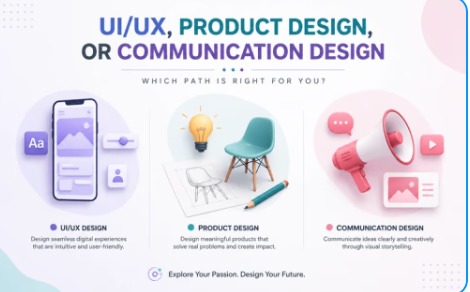
Should You Choose UI/UX, Product Design, or Communication Design?
Students can specialise in fields such as UI/UX Design, Product Design, and Communication Design based on their interests and long-term goals.
- A Bachelor of Design (BDes) offers diverse career paths. Students can specialise in fields such as UI/UX Design, Product Design, and Communication Design based on their interests and long-term goals.
- Each specialization focuses on a different type of problem-solving. UI/UX Design creates better digital experiences, Product Design develops functional products, and Communication Design builds effective visual communication and branding.
- The right BDes specialization depends on your strengths. Students interested in technology may prefer UI/UX, those who enjoy innovation and making products may choose Product Design, while creative storytellers may find Communication Design a better fit.
- A successful design career requires both creative and technical skills. Design thinking, research, communication, prototyping, and proficiency in industry-standard software are valuable across all specializations.
- India’s expanding technology, manufacturing, media, and creative sectors continue to create opportunities for BDes graduates. Choosing a specialization that matches your interests and building a strong portfolio can support long-term career growth.
Introduction
Every app you use, product you buy, and brand you remember has a designer behind it. But not all designers do the same job.
If you’re considering a BDes, you’ll likely come across three popular specializations: UI/UX Design, Product Design, and Communication Design. Each offers a different way to solve problems, build experiences, and shape the world around you.
This guide will help you understand the differences so you can choose the specialization that best matches your interests and career goals.
What Is B.Design in India?
A Bachelor of Design (BDes) is a four-year undergraduate degree that prepares students for professional careers in design. The course combines creativity, technology, research, and problem-solving to develop practical industry skills.
In India, universities and design institutes offer BDes programs across multiple specializations. Students study design principles, visual communication, drawing, digital tools, user behaviour, material studies, and project development before moving into specialized subjects.
A BDes course differs from traditional fine arts programs because it focuses on creating solutions for real-world challenges. Students work on industry projects, design thinking exercises, and portfolio development throughout the program.
Many Indian institutions offer BDes specializations such as UI/UX Design, Product Design, Communication Design, Fashion Design, Interior Design, and Animation. The curriculum balances classroom learning with practical workshops and internships.
A BDes degree helps students build technical expertise and creative thinking for careers in technology, manufacturing, branding, media, and product innovation.
What Does a BDesign Course Include in India?
A BDesign course in India typically spans four years and follows a semester-based structure. The curriculum builds foundational design skills before introducing specialized subjects.
During the first year, students study design fundamentals, visual representation, colour theory, typography, sketching, digital graphics, and design thinking. These subjects create a common foundation across design disciplines.
From the second year onwards, students begin specialization-focused learning. Depending on the institute, they may choose UI/UX Design, Product Design, Communication Design, Animation, Fashion Design, or other fields.
A typical Design course includes:
- Design fundamentals
- User research
- Visual communication
- Material and manufacturing studies
- Digital design software
- Prototyping techniques
- Branding and storytelling
- Human-centred design
- Portfolio development
Most institutions also include workshops, studio projects, internships, and industry collaborations. Students work on practical assignments that simulate professional design environments.
The final year usually focuses on advanced electives, live projects, internships, and a graduation project that demonstrates technical knowledge and creative problem-solving.
Explore more about the B.Design course at Rishihood University! UI/UX Design vs Product Design vs Communication Design
Many students exploring a Bachelor of Design (BDes) course ask the same question: Which specialization should I choose? UI/UX Design, Product Design, and Communication Design all involve creativity and problem-solving, but they focus on different types of work and career paths.
The easiest way to understand them is by looking at what designers create.
UI/UX Design
UI/UX Design focuses on digital products such as websites, mobile apps, and software platforms. Designers study how people use technology and create interfaces that are simple, attractive, and easy to navigate.
If you enjoy technology, solving user problems, and designing digital experiences, UI/UX Design could be a suitable choice.
Product Design
Product Design focuses on creating products that people use in everyday life. These can include furniture, electronics, medical devices, packaging, home appliances, and even digital products.
Students learn how to research user needs, develop ideas, build prototypes, and improve products before manufacturing. The field combines creativity with practical problem-solving.
If you enjoy making things and understanding how products work, Product Design may suit your interests.
Communication Design
Communication Design focuses on sharing ideas through visuals. Designers create brand identities, advertisements, social media graphics, magazines, packaging, and marketing campaigns.
The specialization combines art, storytelling, typography, and digital media to help businesses and organisations communicate with their audiences.
If you enjoy drawing, branding, content creation, and visual storytelling, Communication Design can be a good career path.
Which One Should You Choose?
Your interests can help you decide:
- Choose UI/UX Design if you enjoy apps, websites, and digital technology.
- Choose Product Design if you like creating useful products and solving practical problems.
- Choose Communication Design if you enjoy branding, graphics, and creative storytelling.
There is no single “best” BDes specialization in India. The right choice depends on the type of work you enjoy and the career you want to build.
To know more about the course in detail, download the brochure here! Who Should Choose UI/UX Design in India?
UI/UX Design suits students who enjoy solving digital problems and improving user experiences. The specialization combines research, creativity, and technology to build effective digital products.
Students interested in understanding user behaviour often perform well in UI/UX. The field requires analysing user needs, conducting research, creating wireframes, and testing design solutions.
UI designers focus on visual layouts, navigation systems, typography, and interactive elements. UX designers improve the overall user journey by identifying pain points and simplifying tasks.
Common skills include:
- User research
- Information architecture
- Wireframing
- Prototyping
- Interaction design
- Usability testing
- Design systems
- Accessibility principles
Students regularly use tools such as Figma, Adobe XD, Miro, and prototyping platforms.
UI/UX Design aligns with industries that build digital products, including technology companies, fintech, healthcare, education, e-commerce, and software services.
Common career roles include:
- UI Designer
- UX Designer
- Product Designer
- Interaction Designer
- UX Researcher
- Information Architect
- Design System Specialist
Students who enjoy combining creativity with analytical thinking and digital technology may find UI/UX Design a suitable career path.
Who Should Choose Product Design in India?
Product Design suits students who enjoy creating solutions that combine functionality, aesthetics, and usability. The field covers both physical and digital products, depending on the project and industry.
Students interested in engineering concepts, materials, manufacturing, and human-centred design often find Product Design engaging. The specialization focuses on understanding user needs and transforming ideas into practical products.
Key learning areas include:
- Product research
- Sketching and ideation
- Ergonomics
- Material studies
- CAD modelling
- Prototyping
- Design for manufacturing
- Sustainability considerations
Students build prototypes using digital modelling software and physical fabrication techniques. Many projects involve testing, refining, and preparing products for production.
Product Design has applications across consumer electronics, furniture, medical devices, automotive components, industrial equipment, packaging, and digital products.
The specialization connects closely with manufacturing and industrial innovation. Designers collaborate with engineers, business teams, and production specialists throughout the development process.
Common career opportunities include:
- Product Designer
- Industrial Designer
- Design Researcher
- Furniture Designer
- Packaging Designer
- Innovation Consultant
- Prototype Specialist
Students who enjoy problem-solving, making, and developing practical products for real-world use may benefit from choosing Product Design.
Watch here how a B.Design at Rishihood University landed 5 job offers before even graduating! Who Should Choose Communication Design in India?
Communication Design suits students who enjoy combining creativity with strategic thinking. The specialization focuses on delivering messages through visual elements across print, digital, and interactive platforms.
Students interested in branding, advertising, publishing, and digital media often find Communication Design a suitable choice. The field requires an understanding of design principles, audience behaviour, and visual storytelling.
Key areas of study include:
- Branding and identity design
- Typography
- Illustration
- Advertising design
- Packaging design
- Motion graphics
- Publication design
- Digital content creation
Communication designers create visual systems that help businesses and organizations connect with their audiences. They work on logos, marketing campaigns, social media creatives, websites, magazines, and digital advertisements.
Visual storytelling plays a central role in this specialization. Designers use colours, layouts, images, and typography to communicate ideas clearly across different media formats.
Communication Design has applications in advertising agencies, media companies, publishing houses, digital marketing firms, entertainment, education, and corporate branding.
Common career options include:
- Graphic Designer
- Brand Designer
- Art Director
- Visual Designer
- Packaging Designer
- Publication Designer
- Motion Graphics Designer
Students who enjoy creative expression, branding strategies, and multimedia communication may find Communication Design an ideal BDes specialization.
Visual Communication Design Careers in India
Visual Communication Design creates opportunities across India’s growing media, branding, and digital industries. Businesses require visual content to build brand identity and engage customers across multiple platforms.
Graduates work in sectors such as:
- Advertising
- Branding agencies
- Publishing
- Entertainment
- Television
- Digital marketing
- Social media
- E-commerce
- Education technology
Common job roles include:
- Graphic Designer
- Visual Designer
- Brand Identity Designer
- Packaging Designer
- Art Director
- Motion Graphics Designer
- Creative Designer
- Content Designer
Visual communication professionals develop advertising campaigns, digital assets, packaging designs, corporate branding systems, editorial layouts, and marketing materials.
The demand for visual content has expanded with digital transformation. Companies seek designers who can create consistent brand experiences across websites, mobile applications, social media platforms, and offline marketing channels.
Freelancing and entrepreneurship also provide career opportunities. Many designers work independently with startups, agencies, and established businesses while building specialized portfolios.
A strong portfolio, practical experience, and software proficiency often play a significant role in career growth within the creative industry.
BDesign Course Fees in India
BDes course fees in India vary depending on the institution, facilities, and specialization offered.
Government design institutes generally have lower tuition fees because of public funding. Students may also access scholarships and financial assistance schemes.
Private universities often charge higher fees due to advanced infrastructure, industry collaborations, studio facilities, and international exposure.
Typical fee categories include:
Institution Type Approximate Annual Fee Government Colleges ₹1 lakh–₹4 lakh Private Universities ₹3 lakh–₹8 lakh or higher Apart from tuition fees, students should consider expenses for materials, software, workshops, hostel accommodation, and project development.
Fee structures differ across institutions and may change each academic year. Students should review the official admission information before applying.
Scholarships, merit awards, and education loans can help reduce the overall cost of pursuing a Bachelor of Design degree.
Bachelor of Design Eligibility and Entrance Exams in India
Students can pursue a Bachelor of Design after completing Class 12 from a recognised board. Most institutions accept candidates from Science, Commerce, and Humanities backgrounds.
General eligibility requirements include:
- Completion of Class 12 or equivalent.
- Minimum qualifying marks as specified by the institution.
- Entrance examination and portfolio requirements where applicable.
Several Indian design institutions conduct entrance examinations to assess creativity, logical thinking, observation skills, and problem-solving abilities.
Major entrance exams include:
UCEED
The Undergraduate Common Entrance Examination for Design serves admission to participating institutes. The test evaluates visualisation, analytical reasoning, creativity, and design aptitude.
NID DAT
The National Institute of Design Design Aptitude Test includes preliminary and studio-based assessments. Candidates demonstrate creativity, observation, and practical design abilities.
Private University Entrance Exams
Many private universities conduct independent admission tests, interviews, studio exercises, and portfolio reviews. Some institutions also accept national-level entrance scores.
Preparation usually involves:
- Sketching practice
- Visual observation
- Logical reasoning
- Creative problem-solving
- General design awareness
Students should verify eligibility criteria and admission procedures because requirements differ across institutions and specializations.
Apply now using your rank at any of the national-level design exams and get a great scholarship! Skills Required for UI/UX, Product Design, and Communication Design
Successful design students combine creativity with technical and analytical abilities. Each specialization requires a balance of practical and conceptual skills.
Important skills include:
- Design thinking
- Creative problem-solving
- Analytical reasoning
- Sketching and visualisation
- User observation
- Communication skills
- Research abilities
- Collaboration
- Time management
- Presentation techniques
UI/UX Design places additional emphasis on user research and interaction planning.
Product Design requires understanding form, function, ergonomics, and prototyping.
Communication Design focuses on visual storytelling, branding, and audience engagement.
Adaptability and continuous learning remain important because design tools and industry practices evolve regularly.
Software Tools Used Across B.Design Specializations
BDes students use a combination of creative, technical, and prototyping software throughout their academic projects.
Common tools include:
Tool Primary Use Figma UI/UX design and prototyping Adobe Photoshop Image editing Adobe Illustrator Vector graphics Adobe InDesign Publication design Adobe After Effects Motion graphics Blender 3D modelling and animation AutoCAD Technical drafting Fusion 360 Product development Rhino Industrial design SolidWorks Engineering and product modelling UI/UX students commonly work with Figma and interface design platforms.
Product Design students use CAD software and 3D modelling tools for product development.
Communication Design students rely on Adobe Creative Suite for branding, advertising, and visual communication projects.
Learning multiple tools helps students adapt to different industries and project requirements.
Salary Comparison for Design Careers in India
Salary levels for design professionals depend on specialization, skills, location, portfolio quality, and industry sector.
Specialization Typical Entry-Level Roles UI/UX Design UI Designer, UX Designer Product Design Product Designer, Industrial Designer Communication Design Graphic Designer, Brand Designer Technology companies, product startups, consulting firms, manufacturing businesses, branding agencies, and media organisations recruit BDes graduates.
UI/UX professionals commonly work in software and digital product companies.
Product designers find opportunities in manufacturing, consumer products, healthcare, automotive, and industrial sectors.
Communication designers contribute to branding agencies, advertising firms, publishing, entertainment, and digital media companies.
Salary growth often depends on practical experience, portfolio strength, specialization, and leadership responsibilities rather than academic qualifications alone.
Graduates who build multidisciplinary skills and practical project experience can explore diverse career paths across India’s expanding creative economy.
Which B.Design Specialization Has Better Scope in India?
No single BDes specialization suits every student. The best choice depends on personal interests, career goals, and preferred work environments.
This comparison can simplify the decision:
Interest Suitable Specialization Digital products UI/UX Design Consumer and industrial products Product Design Branding and media Communication Design UI/UX Design aligns with industries that build websites, applications, and digital services.
Product Design supports innovation across manufacturing, consumer goods, healthcare, mobility, and technology sectors.
Communication Design connects with advertising, publishing, digital marketing, entertainment, and corporate branding.
Students should consider four factors before selecting a specialization:
- Preferred problem-solving style
- Interest in technology or physical products
- Creative strengths
- Long-term career aspirations
A simple decision framework:
- Choose UI/UX if you enjoy digital experiences.
- Choose Product Design if you like creating practical products.
- Choose Communication Design if you enjoy visual storytelling and branding.
The strongest career outcomes often come from selecting a specialization that matches individual skills and sustained interest rather than following short-term market trends.
Explore B.Design Specializations at Rishihood University
Choosing a BDes specialization shapes the skills, projects, and career opportunities you develop during your undergraduate studies. Understanding the differences between UI/UX Design, Product Design, and Communication Design can help you make an informed decision.
A design education should combine creative exploration with practical industry exposure. Studio projects, interdisciplinary learning, internships, and portfolio development prepare students for evolving professional environments.
Rishihood University offers design education that encourages problem-solving, innovation, collaboration, and hands-on learning. Students can explore different areas of design while developing technical and creative capabilities through project-based experiences.
Prospective students should evaluate curriculum structure, faculty expertise, industry collaborations, campus facilities, and career support before choosing a BDes programme.
If you want to build a career in digital experiences, product innovation, or visual communication, exploring available BDes specializations and admission requirements can help you identify the pathway that aligns with your interests and long-term goals.
-
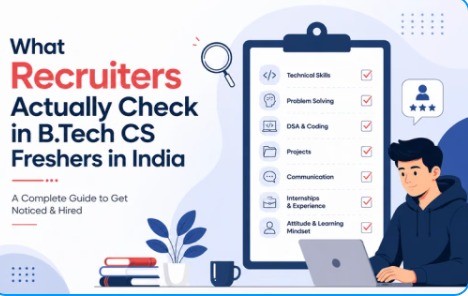
What Recruiters Actually Check in B.Tech CS Freshers in India in 2026
What are recruiters actually looking for? In 2026, a B.Tech Computer Science degree alone isn’t enough to stand out.
- Recruiters in 2026 hire for skills, not just degrees. Strong DSA knowledge, technical fundamentals, practical projects, internships, and problem-solving ability often influence hiring decisions more than academic credentials alone.
- Resume screening has become more technology-driven. ATS systems, AI-assisted recruitment tools, GitHub portfolios, project documentation, and relevant keywords play a major role in determining whether a B.Tech CS fresher reaches the interview stage.
- Industry readiness creates a competitive advantage. Candidates who combine technical skills, communication ability, internship experience, cloud and AI exposure, and continuous learning are more likely to secure higher-paying opportunities across product and service-based technology companies
Introduction
Before landing your first software engineering job, there’s one question worth asking: What are recruiters actually looking for? In 2026, a B.Tech Computer Science degree alone isn’t enough to stand out. Employers want graduates who can build, solve, communicate, and adapt to real-world challenges. Whether you’re interested in AI, cybersecurity, software development, cloud computing, or business analytics, your portfolio, projects, internships, and practical skills often matter just as much as your academic performance. So, how do you prepare for the hiring process before you even graduate? In this article, we’ll break down what recruiters evaluate at every stage of hiring and how engineering students can build the skills that truly make them industry-ready.
India Tech Hiring Trends for Freshers in 2026
The way tech companies hire engineering graduates has changed. In 2026, having a B.Tech degree is still important—but it’s no longer what sets you apart. Recruiters want to know what you’ve built, the problems you’ve solved, and whether you can apply your knowledge in real-world situations.
From coding challenges and technical interviews to project portfolios and internships, companies are looking for students who can demonstrate their skills, not just talk about them. Many recruiters also use AI-powered tools to screen resumes, making it more important than ever to showcase relevant projects, technical expertise, and practical experience.
Whether you’re aiming for a role in software development, AI, cybersecurity, cloud computing, or data analytics, the students who stand out are those who graduate with both strong fundamentals and hands-on experience. Today’s hiring landscape rewards curiosity, initiative, and the ability to solve real problems—qualities that employers value just as much as academic performance.
Meet the B.Tech CS & Data Science learners who secured internships at Pertech, a US-based company. What Recruiters Notice Before They Even Read Your Resume
Here’s something most engineering students don’t realize: your resume isn’t the first thing recruiters evaluate.
Before they look at your projects or technical skills, recruiters (and often AI-powered hiring systems) quickly check whether your profile meets the basic requirements. That includes your academic background, specialization, consistency in performance, and whether your resume clearly communicates what you bring to the table.
But once you clear that first filter, what really makes you stand out isn’t your CGPA—it’s what you’ve actually built.
That’s why at Rishihood University’s B.Tech CS & Data Science program, students don’t wait until their final year to work on real projects. From the very first year, the curriculum is designed around building practical skills through hands-on coding, open-source contributions, industry-led projects, hackathons, and internships. By the time students begin applying for internships and placements, they already have a portfolio that demonstrates their ability—not just a degree.
Why Your Resume Needs to Work for Humans and AI
Today, your resume is often read by software before it’s read by a recruiter.
Most technology companies use Applicant Tracking Systems (ATS) to screen thousands of applications. These systems look for relevant programming languages, frameworks, technical skills, internships, certifications, and project experience before deciding whether your resume should move to the next stage.
A strong project section, clear internship experience, and the right technical keywords can significantly improve your chances of getting shortlisted.
This is another reason practical learning matters. Throughout the curriculum at Rishihood, students continuously build software, solve real-world problems, and work on industry projects. Whether it’s developing applications, participating in hackathons, contributing to open-source projects, or completing internships, every experience helps strengthen both their skills and their resume.
The takeaway is simple: recruiters don’t just hire graduates—they hire people who can demonstrate what they know. The strongest resumes are backed by real work, meaningful projects, and experiences that prove you’re ready to contribute from day one.
Build the Skills Recruiters Actually Hire For What Technical Skills Do Recruiters Actually Look For?
A B.Tech degree gets your foot in the door—but your skills are what get you hired.
When recruiters interview engineering graduates, they’re looking for people who understand the fundamentals and can apply them to solve real problems. It’s not about memorizing concepts for exams; it’s about showing that you can think like an engineer.
Here’s what recruiters expect every Computer Science graduate to know:
- Programming Languages: Be comfortable writing code in languages like Python, Java, C++, or JavaScript.
- Data Structures & Algorithms (DSA): Solve coding problems efficiently using arrays, strings, linked lists, trees, graphs, and dynamic programming.
- Databases: Understand SQL, database design, and how to work with large datasets.
- Operating Systems: Know the basics of memory management, processes, scheduling, and file systems.
- Computer Networks: Understand how the internet works—from HTTP and TCP/IP to DNS and network security.
- Object-Oriented Programming (OOP): Apply concepts like inheritance, polymorphism, abstraction, and encapsulation while building software.
- Cloud Fundamentals: Gain familiarity with cloud platforms, deployment, storage, and modern application architecture.
The difference between an average candidate and a standout one? Hands-on experience.
That’s what learning by doing looks like. Watch Lakshay, a B.Tech CS & Data Science learner at SASTech, talk about winning a hackathon at IIT Roorkee and how hands-on learning helped him compete with some of the country’s best engineering students. That’s why the curriculum at SASTech, Rishihood University is built around learning by doing. Instead of waiting until your final year, you’ll work on real projects, contribute to open-source software, participate in hackathons, build AI applications, and gain industry experience through internships from the very beginning.
By the time you graduate, you’ll have more than technical knowledge—you’ll have a portfolio that demonstrates what you can build.
Why DSA Still Matters
If there’s one skill that almost every technology recruiter tests, it’s Data Structures and Algorithms (DSA).
Whether you’re interviewing for a startup or a global tech company, coding assessments almost always include DSA-based questions. Recruiters want to see how you approach problems, optimize your code, and think under pressure.
Some of the most commonly tested topics include:
- Arrays and Strings
- Linked Lists
- Stacks and Queues
- Trees and Graphs
- Recursion and Backtracking
- Dynamic Programming
- Searching and Sorting Algorithms
- Hash Maps and Sets
At SASTech, DSA isn’t treated as just another subject. Students regularly practice coding challenges, participate in competitive programming, work on real-world projects, and receive mentorship from industry experts—building the confidence to tackle technical interviews from day one.
Ready to Build the Skills Recruiters Want?
The best engineering graduates don’t just earn a degree—they graduate with projects, internships, coding experience, and the confidence to solve real-world problems.
Apply to SASTech’s B.Tech Computer Science & Data Science program and start building the skills that technology companies are hiring for. Why Internships Matter More Than Ever
An internship is more than a line on your resume—it’s proof that you can apply what you’ve learned in a real workplace.
When recruiters review internship experience, they’re not just looking at the company name. They want to understand what you worked on, the problems you solved, and the impact you created.
The strongest internships usually include:
- Working on live products, software, or client projects.
- Taking ownership of real tasks instead of simply observing.
- Building features, fixing bugs, analyzing data, or automating workflows.
- Collaborating with teams using industry tools and best practices.
- Delivering measurable outcomes that you can confidently talk about during interviews.
This is why internships are embedded into the learning journey at SASTech, Rishihood University. Students gain hands-on industry exposure through internships, live projects, hackathons, and startup collaborations, ensuring they graduate with experience—not just coursework.
Your Degree Builds the Foundation. Your Projects Build Your Career
Every B.Tech Computer Science curriculum teaches programming, databases, operating systems, computer networks, and software engineering.
But today’s recruiters expect much more.
They want graduates who can:
- Build and deploy real applications.
- Work with Git and modern development tools.
- Collaborate in teams using industry workflows.
- Solve practical engineering problems.
- Communicate their ideas clearly.
- Adapt quickly to new technologies.
That’s exactly why SASTech follows a foundations-first, learning-by-building approach. From the first year onwards, students work on industry projects, open-source contributions, hackathons, internships, and product development experiences that bridge the gap between classroom learning and workplace expectations.
By graduation, students don’t just understand computer science—they know how to apply it.
What Recruiters Expect from AI & Machine Learning Graduates
The demand for AI and Machine Learning professionals continues to grow—but employers are looking for much more than a specialization on your degree.
Recruiters want graduates who can:
- Build and train machine learning models.
- Work with real-world datasets.
- Use Python libraries like NumPy, Pandas, and Scikit-learn.
- Understand model deployment and cloud-based AI workflows.
- Showcase AI projects that solve real problems.
A strong portfolio often makes a bigger impression than simply listing “AI & ML” on your resume.
At SASTech, students don’t just study AI—they build with it. Through project-based learning, mentorship, hackathons, and industry collaborations, they gain the confidence to develop solutions that reflect real business and societal needs.
Why Business Analytics Is Becoming a Must-Have Skill
Technology is no longer just about writing code—it’s about making better decisions with data.
That’s why companies increasingly value engineers who understand both technology and business.
Some of the most sought-after skills include:
- Writing SQL queries to work with large datasets.
- Creating dashboards and reports that drive business decisions.
- Identifying patterns and trends using data.
- Presenting insights in a way that stakeholders can understand.
- Using analytics tools to solve real business challenges.
Graduates who combine technical expertise with analytical thinking are often better prepared for roles in product management, consulting, business intelligence, data analytics, and AI.
At SASTech, students develop these skills by working on interdisciplinary projects that combine engineering, AI, data science, and business problem-solving—preparing them for the careers shaping the future.
Ready to Build More Than Just a Degree?
The engineers who stand out in 2026 aren’t the ones who simply complete a syllabus—they’re the ones who graduate with real projects, internships, technical expertise, and the confidence to solve meaningful problems.
If you’re looking for a program that combines strong computer science fundamentals with hands-on learning, industry exposure, AI, data science, and real-world experience, SASTech’s B.Tech Computer Science & Data Science is built for you.
Apply today and start building the skills recruiters are looking for—long before graduation.
-
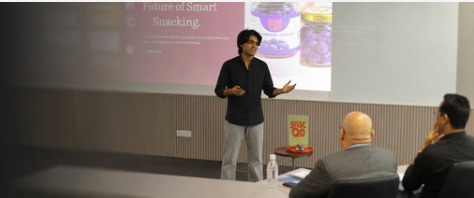
Is Entrepreneurship a Safe Career Option in India for College Graduates?
The blog discusses if Entrepreneurship is really a Safe Career Option in India for College Graduates?
Startups are everywhere. Every day, there’s a new founder story, a funding announcement, or someone telling you to “take the leap.” Moreover, lately India’s startup story looks irresistible from the outside. The country now has nearly 1,97,692 DPIIT-recognised startups as of October 2025, and the ecosystem has created over 21.11 lakh direct jobs so far, making it the world’s third-largest startup hub.
But when it’s your future on the line, the question changes. Should you take a stable job or bet on building something of your own?
The answer isn’t the same for everyone. In this guide, we’ll help you weigh the risks, rewards, and realities of entrepreneurship, so you can decide if it’s the right path for you.
The Core Concern: Stable Job vs Entrepreneurship
For most Indian graduates, the decision isn’t romantic, it’s financial. A monthly salary pays education loan EMIs, supports family expenses, and builds a credit history. Entrepreneurship, especially in the first 18-24 months, usually pays nothing and can require capital from the founder’s own savings or family.
Interestingly, research contradicts the usual ‘Entrepreneurship is riskier’ assumption. A UCLA Anderson study found entrepreneurship in India can carry comparatively lower personal risk than in wealthy nations, partly because of strong family and community safety nets that cushion failure. Something rare in the West, where a failed founder often has no fallback support system. This doesn’t mean entrepreneurship is ‘safe’ in India; it means the safety net comes from family structure and frugal living norms, not from the business itself.
Instead of treating it as a simple choice between a job and entrepreneurship, ask better questions: Safe for whom? Risky for whom? And when does formal entrepreneurship education meaningfully improve the chances of success?
A Practical Safety Framework in Entrepreneurship Career
Safe For Whom
Entrepreneurship is a reasonably safe starting career path for a graduate who has at least three of the following: a family business to fall back on or learn from, low fixed financial obligations (no large loan EMIs or dependents to support immediately), a skill that can generate freelance or consulting income as a backup, access to early-stage capital without high-interest debt, and genuine exposure to a market or industry through internships, family networks, or prior project work. For someone with this profile, a failed venture may cost time and some savings, but it is less likely to affect their ability to pay rent, support their family, or meet essential living expenses.
Risky For Whom
It becomes genuinely risky for a graduate who is the primary income hope for the family, has an education loan needing repayment from month one, has no industry exposure or validated customer insight, is funding the idea through high-interest personal debt, and has no fallback skill to generate income if the venture stalls. For this profile, a job, even an average one is the financially rational first move, with entrepreneurship attempted later once a cushion exists.
When to Choose Entrepreneurship Education Over Direct Founding
A formal entrepreneurship degree or course makes sense when a graduate wants the upside of business ownership but currently lacks the two things that determine survival: structured business skills (finance, unit economics, legal compliance, marketing) and a tested network (mentors, co-founders, early customers). Rather than jumping straight in, a course-based or incubator-based pathway such as a BBA in Entrepreneurship reduces the ‘lack of business skills’ and ‘poor planning’ risks that account for a large share of early-stage shutdowns.
When Entrepreneurship Makes Sense for Indian Graduates
There’s a meaningful difference between ‘wanting to be a founder’ and being structurally positioned to start now. Entrepreneurship makes the most sense when a graduate has at least one of these in place:
- A skill-based career path: Coders, designers, content creators, and analysts can often start a venture around a service they can already deliver, with near-zero inventory or capital risk.
- A family business background: Succeeding into an existing operation, or extending it digitally, is fundamentally lower-risk than starting from zero, since distribution, capital, and credibility already exist.
- Industry exposure: Graduates who interned in a sector for 1-2 years understand its real pain points, supplier relationships, and customer behaviour, which sharply reduces ‘no market validation’ risk.
- Low-capital startup pathways: Service businesses, D2C resale models, content/creator businesses, or SaaS tools that don’t need manufacturing infrastructure let a graduate test an idea on a shoestring budget before committing fully.
Want to launch Your Entrepreneurial Journey? Apply now! When Entrepreneurship Becomes Risky in India
On the flip side, four patterns consistently show up in failed first ventures by young Indian founders.
- Financial instability is the most common: Founders underestimate how long it takes to break even and run out of personal runway before gaining traction.
- No market validation: Building based on assumption rather than testing with real paying customers wastes months and capital.
- Lack of business skills: This shows up as poor pricing, weak cash-flow tracking, and compliance gaps.
- Poor planning: No realistic runway calculation, no contingency plan, no clarity on when to pivot.
None of these are reasons to avoid entrepreneurship altogether. They’re reasons to either delay the leap until the gap is closed, or pursue it through a structured, lower-capital pathway first, closely guided by mentors, which is the model Rishihood’s School of Entrepreneurship is built around.
Entrepreneurship vs Job: A Direct Comparison
Factor Stable Job Entrepreneurship Income in Year 1 Predictable, monthly Often zero or negative Risk of failure Low (barring layoffs) High in first 2-3 years Skill building Role-specific, narrower Broad: Finance, Sales, Operations, HR Growth ceiling Capped by hierarchy/appraisals Theoretically uncapped Support system needed Minimal Strong family/financial cushion helps Best suited for Loan EMIs, dependents, low risk appetite Low fixed costs, validated idea, fallback skill India-specific advantage Large organised and MSME job market MSME sector contributes around 31.1% to India’s GDP and supports over 32.82 crore jobs, showing room for small ventures to scale. This table isn’t meant to declare a winner. It’s meant to show that the two paths optimise for different things: Predictability versus Optionality, and a graduate’s personal financial situation should decide which one to prioritise first.
Graduate-Specific Career Pathways in Entrepreneurship
Entrepreneurship doesn’t only mean ‘founding a startup’. For graduates evaluating this space, there are at least five distinct entry points, each with a different risk profile.
Startup founder is the highest-risk, highest-upside path: building from scratch, usually pre-revenue, often self-funded or angel-funded in year one.
Family business successors are comparatively lower-risk: stepping into an existing operation and applying entrepreneurial thinking to scale or digitise it, rather than starting from zero.
A business development role at an early-stage startup offers entrepreneurial exposure: deal-making, partnerships, market expansion with the safety of a fixed salary, a good ‘test the waters’ option.
Product role at a startup or scale-up lets a graduate build, ship, and iterate on real products, learning operational discipline without personally bearing financial risk.
A venture analyst role at a VC fund or incubator builds structural understanding of how startups are evaluated and funded. Useful both as a career and as preparation for founding later with sharper judgment.
A graduate unsure about direct founding can use roles two through five as a low-risk apprenticeship into entrepreneurial thinking before ever risking personal capital. Programs that build real-world founder exposure early like the live ventures and mentorship built into Rishihood’s BBA in Entrepreneurship, compresses and packs this apprenticeship into the degree itself.
Entrepreneurship Courses After 12th in India
For students deciding their undergraduate path right after school, several structured options build entrepreneurial capability without forcing an immediate, high-risk leap into founding.
Undergraduate pathways include a BBA in Entrepreneurship, BMS with an entrepreneurship specialisation, and integrated programs at institutions with dedicated E-Cells and incubators. These combine business fundamentals with hands-on project work.
Certifications from platforms and institutions (lean startup methodology, financial modelling, digital marketing, GST and compliance basics) let students build specific, immediately usable skills alongside a regular degree.
Business-focused education: Commerce or economics degrees paired with entrepreneurship electives gives a broader foundation in markets, taxation, and consumer behaviour that supports both job-seeking and founding later.
Skill-building structure through college incubation cells, Atal Tinkering Labs (for the school-to-college pipeline), and pre-incubation bootcamps exposes 17-19 year-olds to real founder mentorship before they’ve committed years to a single path.
The goal of post-12th entrepreneurship education isn’t to manufacture founders by 21. It’s to build the financial literacy, planning discipline, and market awareness that later make any chosen path, job or venture more likely to succeed.
BBA in Entrepreneurship in India
A BBA in Entrepreneurship has become one of the more popular specialised undergraduate degrees for students who know early they want a founder or venture-adjacent career.
The curriculum typically covers new venture creation, financial planning for startups, marketing for early-stage businesses, legal and regulatory frameworks, and increasingly, digital and D2C models.
Startup incubation exposure is the biggest differentiator. Most BBA-Entrepreneurship programs run through colleges with active incubation cells, giving direct access to mentors, seed-stage funding rounds, and pitch competitions during the degree itself.
Career pathways split three ways: direct founding (often a low-capital service or D2C venture), joining a startup in a business or growth role, or moving into venture capital, incubation, or government startup-support roles.
The difference from general BBA is mainly depth versus breadth. A general BBA gives wide exposure to all business functions for corporate roles, while a BBA in Entrepreneurship trades some breadth for deeper, applied focus on building a new venture from scratch. The full curriculum, mentor network, and admissions details for one such program are laid out in Rishihood’s BBA in Entrepreneurship brochure.
Apply now if entrepreneurship is the right path for you. BBA Entrepreneurship vs General BBA
Parameter General BBA BBA in Entrepreneurship Core focus Broad management functions Venture creation and growth Typical first job Corporate roles (sales, ops, finance, HR) Startup roles, founding, BD, venture analysis Practical exposure Internships, case studies Incubation cells, pitch competitions, mentorship Risk tolerance needed Lower Higher, but better prepared for it Best fit for Students preferring structured corporate growth Students with a venture idea or family business background Family Business and Entrepreneurship in India
Family-owned businesses remain one of the most overlooked and statistically safer pathways into entrepreneurship for Indian graduates because much of the foundation, including capital, supplier relationships, customer trust, and brand recognition, is already in place.
Succession planning has also become more structured. Instead of taking over the business immediately, many young entrepreneurs first gain experience across different departments while pursuing a BBA in Entrepreneurship.
This is where graduates can make the biggest impact by introducing digital marketing, data-driven inventory management, e-commerce, and other modern business practices to help traditional businesses grow.
Digital transformation is another major opportunity. Many family businesses are moving from manual accounting to ERP systems and from word-of-mouth marketing to social commerce, creating space for the next generation to lead meaningful change.
Modern business leadership also involves professionalising governance by separating ownership from management, introducing performance metrics, and building systems that support long-term growth. Graduates with formal entrepreneurship education are often better equipped to drive these changes.
Learn business by doing business. Apply now for BBA Entrepreneurship program at Rishihood University Startup vs Family Business: A Comparison
Factor New Startup Family Business Starting capital Usually self-funded or external Often pre-existing Market trust Built from scratch Inherited Risk of total failure Higher Lower, but risk of stagnation Decision-making Founder-led, fast Often consensus-driven, slower Growth potential Uncapped but unproven Steady, with scope for digital scale-up Best suited for First-generation entrepreneurs with a validated idea Graduates with an existing family enterprise to modernise Startup Ecosystem Support for Entrepreneurs in India
A graduate evaluating entrepreneurship today has more structured government support than any previous cohort.
Startup India has recognised 1,97,692 entities as of 31st October 2025, under the eligibility criteria of G.S.R. Notification 127(E), with eligible startups gaining tax exemptions, compliance relaxations, and easier registration.
Incubators are core to this — the Startup India Seed Fund Scheme, with a corpus of INR 945 crore, provides grants of up to INR 20 lakh for prototype development and up to INR 50 lakh as seed funding, channelled through 219 approved incubators nationwide.
Government schemes extend further — the Credit Guarantee Scheme for Startups offers collateral-free loans, and the Fund of Funds for Startups, with a corpus of Rs. 10,000 crore, channels capital to SEBI-registered Alternative Investment Funds that invest in startups.
University startup ecosystems are expanding alongside this — state-level missions and college incubation cells now form a continuous pipeline from campus idea to DPIIT recognition. University-led incubation also extends into global collaborations: Rishihood, for instance, recently co-hosted a 3-day health hackathon with MIT’s Jonathan Fenton, aimed at building grassroots health solutions in India.
Importantly, the government has also pushed back on the “startups are collapsing” narrative — officials have stated there is no noticeable rise in startup closures, with the roughly 6,400 closed entities attributed largely to business model challenges, weak market demand, funding constraints, and economic conditions rather than a systemic ecosystem failure.
Rishihood University Entrepreneurship Programs in India
Among newer-generation universities built specifically around entrepreneurial outcomes, Rishihood University’s programs illustrate what a structured, India-focused entrepreneurship education increasingly looks like.
Entrepreneurship-focused learning is built into the core curriculum rather than offered as an elective — through the School of Entrepreneurship (SoEn), students work on live ventures, business plans, and market validation projects from the early semesters rather than only in a final-year capstone. The complete program structure is available in the BBA in Entrepreneurship brochure.
Industry mentorship is a structural feature, with founders, operators, and investors brought in as direct mentors on student ventures, closing the gap between classroom theory and the operational reality of running a business — an approach rooted in the university’s stated mission and vision.
Family business orientation is also catered to — students coming from business families can use the BBA in Entrepreneurship to formally study succession planning, financial governance, and modernisation strategies relevant to the businesses they’re likely to inherit.
Innovation ecosystem support includes incubation infrastructure, peer-founder networks, and pitch access — designed to reduce exactly the risks discussed earlier: poor planning, no market validation, and lack of business skills. This ecosystem is shaped by Rishihood’s Board of Founders and core team, and is reflected in initiatives like the MIT collaboration on grassroots health innovation.
Employability Pathways: Why the Comparison Matters
Graduate employability data adds useful context to the job-versus-entrepreneurship decision. India Skills Report 2025 data, based on over 6.5 lakh candidates and 1,000-plus corporations, shows a 7% rise in graduate employability, reaching 54.81% in 2025, with management graduates leading at 78% employability, followed by engineering at 71.5%. At the same time, a separate industry assessment found overall employability at a lower 42.6%, with non-technical roles like HR and digital marketing seeing the sharpest declines.
The gap between these two figures matters for the entrepreneurship decision: in a job market where employability itself is inconsistent and contested, a validated, low-capital venture in a skill a graduate has already proven — even part-time, alongside a job — can be a more reliable income hedge than waiting indefinitely for the “ideal” placement offer.
Entrepreneurship in India is neither the guaranteed path to wealth that startup success stories often suggest nor the reckless gamble many people fear. Whether it’s the right choice depends on your financial situation, skills, and preparedness.
It is a safer path for graduates who have validated a real market need, kept their financial commitments low, built a fallback skill that can generate income, and have access to a support system such as a family business, savings, or structured entrepreneurship education.
On the other hand, entrepreneurship carries greater risk for graduates with significant loan obligations, family financial responsibilities, or an untested idea funded through debt.
For most graduates, the smartest approach is not choosing between a job and entrepreneurship. It’s choosing the right sequence. Gain experience, build savings, understand the market, strengthen your skills, and then start your venture when you have both the confidence and the financial cushion to do so.
The most practical first move for most graduates isn’t choosing between a job and a startup forever. It’s sequencing: take the job or the family-business role that builds savings and market exposure, use formal entrepreneurship education or a business development/product role to close specific skill gaps, and then start the venture once the financial cushion and validated insight both exist. With over 1.97 lakh DPIIT-recognised startups, a 31%-of-GDP MSME backbone, and a fast-maturing university and incubator ecosystem behind them, Indian graduates today have more structured pathways into entrepreneurship than any previous generation. Universities like Rishihood, through its School of Entrepreneurship and BBA in Entrepreneurship, are building exactly this kind of deliberate, mentor-backed pathway — the safety lies not in the idea alone, but in how deliberately the path into it is built.
-
Can You Earn Well After a Psychology Degree in India?
Entry-level salaries for fresh BSc psychology graduates in India typically range between INR 2.5 to 4 LPA, which is modest
Introduction
Mental health is finally getting the attention it deserves but the number of trained psychologists in India still falls far short of what’s needed. According to the study by Business Standard’s Global Burden of Disease study, nearly one in seven Indians experiences a mental health disorder, yet there are only 0.07 clinical psychologists for every 100,000 people. That gap isn’t just a challenge it’s also creating a growing demand for qualified psychology professionals.
So, can you build a rewarding and well-paying career in psychology? Absolutely. Your earning potential depends on the path you choose, your qualifications, and the experience you gain along the way. In this article, we’ll explore psychology salaries in India, career opportunities across different specialisations, and how a psychology degree can lead to both meaningful work and long-term career growth.
Can You Earn Well After a Psychology Degree in India?
The short answer is yes, with the right pathway. The long answer requires breaking the myth that psychology is a low-income degree.
Entry-level salaries for fresh BSc psychology graduates in India typically range between INR 2.5 to 4 LPA, which is modest but not in comparison with social science or humanities undergraduate degrees. The critical difference with psychology is what happens next: professionals who specialise and accumulate 3-5 years of experience can reach INR 6-9 LPA, while senior clinicians, corporate psychologists, or those in private practice regularly earn INR 12-25 LPA or more.
The trajectory is steep, steeper than in many other disciplines. Because India’s mental health sector is structurally understaffed and growing fast. The India mental health market was valued at USD 20.82 billion in 2025 and is projected to reach USD 27.36 billion by 2034, expanding at a CAGR of over 3%. Earnings follow demand, and demand for trained psychology professionals is only moving in one direction.
Psychology as a Career in India: Demand and Growth
India’s growing mental health crisis has also created an urgent need for more trained psychologists. According to the National Mental Health Survey by NIMHANS, around 150 million Indians need mental health services, yet 80–90% of them never receive the care they need. The shortage of mental health professionals—from psychiatrists to psychologists and counsellors—continues to be one of the biggest challenges.
At the same time, awareness around mental well-being is growing rapidly. Companies are investing in employee mental health, schools and colleges are hiring counsellors, mental health startups are expanding, and initiatives like Tele-MANAS are making psychological support more accessible. For psychology graduates, this means stepping into a field that isn’t saturated—it’s growing, with opportunities across healthcare, education, corporate organizations, research, and digital mental health.
What Can You Do with a Psychology Degree in India?
A psychology degree in India opens doors well beyond clinical practice. Graduates work across healthcare, education, the corporate world, NGOs, research institutions, the legal system, and increasingly in the tech and design industries. Here is a structured view of the main pathways:
Career Track Typical Roles Sector Clinical & Counselling Psychotherapist, Counsellor, Rehabilitation Specialist Hospitals, Clinics, NGOs Organisational HR Consultant, Talent Manager, Employee Wellness Lead Corporate Educational School Counsellor, Educational Psychologist Schools, Colleges Research & Academia Research Assistant, University Faculty Research Institutions, Universities Forensic & Legal Forensic Psychologist, Victim Counsellor Courts, Police, Prisons Child & Developmental Child Psychologist, Special Educator Schools, Therapy Centres UX & Behavioural Design UX Researcher, Behavioural Analyst Tech, Product Companies The range matters: a BSc psychology course equips graduates not just for mental health settings but for any field where understanding human behaviour, communication, and motivation provides a competitive edge.
Highest-Paying Jobs After a BSc Psychology Degree in India
While entry-level salaries in psychology are modest, specific specialisations unlock significantly higher earning potential over a 5-10 year career. Here are the highest-paying roles psychology graduates in India can work toward:
Job Role Average Salary (Mid-Career) Notes Organisational/Industrial Psychologist INR 8–15 LPA Higher in MNCs and consulting firms Clinical Psychologist (with M.Phil/PhD) INR 8–18 LPA Private hospitals, NIMHANS, AIIMS offer top end Neuropsychologist INR 10–20 LPA Specialised; typically requires postgraduate qualification Forensic Psychologist INR 7–14 LPA Courts, law enforcement agencies Sports Psychologist INR 6–15 LPA Emerging; national sports bodies and elite academies Corporate Wellness Consultant INR 8–15 LPA Growing rapidly with EAP adoption UX Researcher INR 8–18 LPA Tech companies; often requires additional UX training School/Educational Psychologist INR 4–8 LPA Stable; government schools and top private institutions Per upGrad’s analysis of highest-paying psychology jobs in India, organisational and clinical psychologists consistently lead on earnings, while roles in technology and forensics are the fastest-growing new entrants.
Want to build a career that combines purpose with opportunity? Explore Rishihood University’s B.Sc. (Hons.) Psychology program and discover how hands-on learning, research, and industry exposure can prepare you for the future of mental health. Salary After a Psychology Degree in India
One of the most common questions students ask is: “Can psychology be a well-paying career?”
The short answer is yes. Your salary usually grows with experience, specialization, and higher qualifications.
Fresh graduate (0–2 years)
Right after a B.Sc. in Psychology, most students begin with entry-level roles such as:
- Psychological Assistant
- Junior Counsellor
- HR Assistant
- Research Associate
Typical starting salaries are:
- ₹2.5–4 LPA
- ₹20,000–33,000 per month
Mid-career (3–6 years)
After a Master’s degree or M.Phil and a few years of experience, professionals often move into specialized roles such as:
- Counselling Psychologist
- Clinical Psychologist
- Organizational Psychology Consultant
Typical salary range:
- ₹6–9 LPA
Senior & specialist roles (6+ years)
With advanced expertise in areas such as:
- Neuropsychology
- Forensic Psychology
- Private Clinical Practice
- Corporate Wellness & Leadership Consulting
professionals can earn:
- ₹10–25+ LPA
The biggest takeaway? A B.Sc. in Psychology is a strong starting point, not the finish line. The more you specialize and gain real-world experience, the more your opportunities—and earning potential—grow.
Learn how Niharica cracked a role of Human Resource Intern at Sewasathi Sahyog Foundation Does a Master’s Degree in Psychology Make a Difference?
In most cases, yes. While a B.Sc. in Psychology gives you a strong foundation, a master’s degree can significantly expand your career options and earning potential.
If you want to become a licensed Clinical Psychologist in India, higher qualifications are essential. To practice independently, the Rehabilitation Council of India (RCI) requires advanced professional training, making postgraduate education an important step for those pursuing clinical practice.
A master’s degree can also open doors to higher-paying and more specialized roles across different fields. The takeaway is simple: a B.Sc. starts your journey, while a master’s helps you specialize, grow your expertise, and unlock higher-paying opportunities.
Government vs Private Sector Careers for Psychology Graduates in India
Understanding which sector suits you matters both for salary expectations and career satisfaction.
Factor Government Sector Private Sector Entry salary INR 3–6 LPA INR 2.5–5 LPA Growth ceiling Structured, slower Higher and faster with specialisation Job security High Moderate to high in clinical roles Typical employers AIIMS, NIMHANS, Defence, Social Welfare Hospitals, MNCs, Schools, Startups, NGOs Work type Broader caseload, policy, community Focused practice, consulting, corporate Autonomy Lower Higher, especially in private practice Government roles such as psychologist positions in public hospitals, defence services, and rehabilitation centres offer job security, pension benefits, and structured pay scales under the 7th Pay Commission.
Private sector roles, particularly in corporate wellness, tech, and senior clinical positions, offer higher earning ceilings and faster progression but require stronger specialisation and networking.
Explore how Taarush a BPsych student at Rishihood University landed his first internship at Kalpavriksha What Does a Career in Psychology Look Like?
A career in psychology isn’t built overnight—it’s built one step at a time. Here’s what that journey can look like:
After Your B.Sc.
This is where you discover what excites you most. You might pursue a Master’s in Psychology, an M.Phil., an MBA in HR, or begin working as a research assistant, counsellor, or HR professional while gaining practical experience.
Build Your Expertise
As you specialize, you’ll take on roles such as a school psychologist, clinical associate, organizational consultant, researcher, or counsellor. This is also when many professionals begin working with hospitals, universities, NGOs, and corporate organizations.
Find Your Niche
With experience, you can choose to specialize in areas like clinical psychology, neuropsychology, forensic psychology, cognitive science, UX research, organizational psychology, or mental health and well-being. Specialization often brings greater responsibility, impact, and higher earning potential.
Watch how Sneha found her niche in research and got an opportunity to present her research in Italy Lead, Teach, or Build Your Own Practice
Many experienced psychologists go on to lead mental health teams, teach at universities, work as consultants, or build successful private practices that create lasting impact.
The journey starts with choosing the right undergraduate program. One that gives you more than classroom learning—through research, internships, counselling practice, global exposure, and mentorship from experienced faculty
Ready to take the first step? Download the programme brochure or apply to the B.Sc. (Hons.) Psychology program at Rishihood University’s MaNaS School of Brain, Body and Behaviour. Challenges Psychology Graduates Face in India
Modest entry salaries are the most common concern. Fresh BSc graduates in non-metro cities can start at INR 2-3 LPA, which requires financial planning if servicing education loans.
Regulatory requirements mean that practising as a clinical psychologist independently requires an M.Phil or Psy.D from an RCI-approved institution i.e., a 7-9 year academic journey from 12th grade.
Stigma around mental health, though declining rapidly in urban India, still affects client volumes in smaller cities.
Emotional labour is real. Counselling and clinical roles require significant resilience, regular supervision, and self-care practices that aren’t always institutionally supported.
These are not insurmountable, but they are important to plan for. As Deccan Chronicle reported on the mental health crisis in classrooms, the need for trained school counsellors is urgent, yet pay in this segment remains among the lower bands. Graduates must be strategic about which pathway they pursue from the outset, not just reactive once they graduate.
Is a Psychology Degree Worth It?
If you’re someone who’s curious about people, wants to make a meaningful impact, and is looking for a career that’s only becoming more relevant, then the answer is yes.
The demand for psychologists is growing across hospitals, schools, corporate organizations, research labs, NGOs, and even technology companies. But success in psychology isn’t just about earning a degree—it’s about choosing a program that gives you opportunities to apply what you learn through research, internships, community engagement, and real-world practice.
At Rishihood University, students begin building this experience from the start. From working in research labs and counselling centres to collaborating with faculty on meaningful projects, they graduate with much more than classroom knowledge.
Want to see what’s possible? Meet Sayanti, a Rishihood Psychology student who received a ₹2 lakh research grant from the Government of Haryana for her research project. Her journey shows what can happen when you’re given the right mentorship, opportunities, and support from day one.
Frequently Asked Questions
Can you earn well after a psychology degree in India?
Yes, especially with postgraduate specialisation. While entry-level BSc psychology salaries range between INR 2.5-4 LPA, experienced professionals in clinical, corporate, or forensic psychology earn INR 10-25 LPA or more.
What is the average salary after a BSc psychology degree in India?
The average salary for a BSc psychology graduate in India is approximately INR 3.53 LPA at entry level, rising to INR 6-9 LPA with 3-5 years of experience and a postgraduate qualification.
Which psychology specialisation pays the highest in India?
Organisational/industrial psychology, neuropsychology, forensic psychology, and UX research consistently rank among the highest-paying specialisations, often reaching INR 12-20 LPA at senior levels.
Is a master’s degree necessary for a high-paying psychology career?
For clinical practice, an M.Phil or Psy.D recognised by RCI is required to practice independently. For corporate and UX roles, an MSc or MBA-HR combination significantly increases earning potential compared to a BSc alone.
Q. Can psychology graduates work in corporate companies?
Yes. Organisational psychologists, HR consultants, behavioural analysts, UX researchers, and employee wellness professionals are all roles that corporate companies in India actively hire psychology graduates for, often at INR 6-15 LPA at mid-career levels.
-
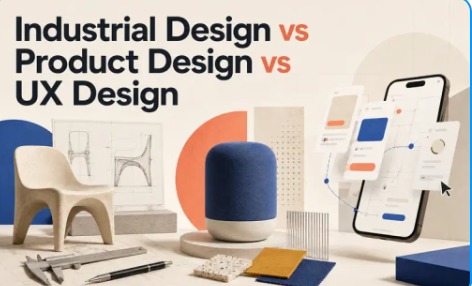
Bachelor of Design (B.Design) 4-Year Program: Subjects You Will Study in India
A Bachelor of Design, or B.Des, is a four-year undergraduate program that trains students to think, research, and create through design. It has following subjects
Introduction
Design today is everywhere, in the app you opened this morning, the packaging of your breakfast, the sign you read on the highway, and the chair you are sitting on. What most people do not see is the years of structured thinking, tool practice, and people-centred problem-solving that went into each of those things.
That is exactly what a Bachelor of Design (B.Design) trains you for. Unlike traditional art programs that focus on self-expression, a B.Des course is built around solving real problems through design making it one of the most versatile undergraduate degrees available today.
India’s demand for trained designers has never been higher. UX/UI design job postings grew by 40% between 2024 and 2026, and India’s UX design market is projected to reach ₹2,244 crore by 2025. India now has over 1,00,000 registered startups, and nearly every funded startup today has at least one dedicated designer on the team.
This article walks you through each year of the four-year B.Design curriculum: the subjects, the skills, the studio work, and the tools so you can understand how the degree actually builds a career-ready designer.
What Is a Bachelor of Design (B.Des)?
A Bachelor of Design, or B.Des, is a four-year undergraduate program that trains students to think, research, and create through design. It is not a fine arts degree. It is not a technology degree. It sits at the intersection of both and pulls from sociology, business, psychology, materials science, and visual communication depending on the specialisation.
The learning approach is studio-based, which means most of your time in a B.Des course is spent building, prototyping, sketching, and presenting work, not sitting in lectures and memorising. Every subject connects to a real-world design challenge.
Most B.Des course programs in India begin with a common foundation year for all students, before splitting into specialisations from Year 2 onwards. Specialisations typically include Communication Design, UX and Interaction Design, and Product Design.
Design thinking i.e., the process of defining a problem, researching users, generating ideas, building prototypes, and testing is not a single subject in a B.Des. It is woven into every year of the curriculum.
After completing a B design course, graduates work as UX designers, product designers, communication designers, visual designers, design researchers, and increasingly, as founders of design-led businesses.
How the 4-Year B.Des Curriculum Is Structured
The four-year bachelor of design curriculum follows an eight-semester model. While specific subjects vary by university, the overall structure across leading Indian design programmes follows a consistent logic.
Year 1 (Semesters 1–2):
A common foundation year. All students, regardless of future specialisation, study design fundamentals, drawing, material exploration, visual communication, and design thinking. This year is about building a shared vocabulary and a strong perceptual base.Year 2 (Semesters 3–4):
Students enter their chosen specialisation track. Core design skills deepen i.e., typography, user research, form studies, CAD, interaction principles, depending on the track. Studio projects become more complex and more tied to real briefs.Year 3 (Semesters 5–6):
Advanced specialisation. Subjects become more focused, like branding, UX/UI, product development, motion design, systems thinking. Students take electives, engage in live client projects, and begin building a professional portfolio.Year 4 (Semesters 7–8):
Professional practice. Students work on a substantial graduation project, complete a 6-month industry internship, and refine their portfolios for placement. Entrepreneurship and design management are introduced.Most B.Des programs in India follow approximately 160 academic credits across eight semesters. Studio-based learning — where work is created, critiqued, revised, and presented — is the core pedagogy throughout. Every year builds directly on the one before.
First-Year B.Design Subjects: Building Design Foundations
The first year is the most important year of a Bdesign course, not because the subjects are the hardest, but because they shape how a student sees and thinks for the rest of the programme.
Across leading Indian B.Des programmes, Year 1 is a common foundation year for all students, regardless of which specialisation they will eventually choose. The subjects typically covered are:
Design Fundamentals:
- Art Appreciation, Art & Design Criticism, and Design History
- Observational Drawing
- Design Fundamentals I & II
- Understanding Geometry and Patterns
- Fabrication Lab / Workshop
- User Studies
- Design Studio – Material Study and Behaviour
- Visualisation and Representation
- Visual Narratives
Interdisciplinary and Contextual Studies:
- History and Philosophy of Design
- Social Communication and Design Ethics
- Cultural Studies and Understanding Society
- Global Challenges and Design’s Role
- Principles of Design
What students actually learn: The drawing and observational work trains the eye to see proportion, light, structure, and detail precisely. Material study teaches how different substances behave, how they flex, break, absorb, and reflect which directly informs product and spatial design decisions later. User Studies introduces the habit of observing real people to understand their needs before designing anything. The interdisciplinary subjects ground all of this in cultural and social context, helping students understand the real-world consequences of design choices.
By the end of Year 1, a student has not yet designed a logo or an app. But they have built the perceptual, material, and research instincts that make everything after this year possible.
Second-Year B.Design Subjects: Developing Core Design Skills
Year 2 is where the curriculum is divided. Students enter their chosen specialisation track i.e., Communication Design, UX and Interaction Design, or Product Design and begin building the technical skills specific to their area.
Subjects across tracks in Year 2:
Communication Design track:
- Typography I and Visual Language
- Layout Design and Graphic Systems
- Colour Systems and Application
- Illustration and Image-making
UX and Interaction Design track:
- Human-Computer Interaction Basics
- Information Architecture
- User Research Methods
- Interaction Design Principles
Product Design track:
- 3D Form Studies
- CAD Fundamentals (AutoCAD and basic modelling)
- Material and Manufacturing Processes
- Product Visualisation
Common across all tracks:
- Research Methods in Design
- Collaborative Studio Projects
- Professional Communication
What students actually learn: Year 2 is when the distinction between ‘studying design’ and ‘thinking like a designer’ starts to feel real. A Communication Design student learns to control type like a visual tool, not just text. A UX student learns that a user flow is not just a diagram but a map of how someone feels as they move through a product. A Product Design student learns that every material choice affects cost, sustainability, and user experience simultaneously. Studio projects in Year 2 require students to apply these skills in response to real design challenges.
Want to explore what each specialisation actually covers? Read: What is Visual Communication Design? | What You Learn in a UX/UI B.Design Programme | Types of Product Design and Career Options
Third-Year B.Design Subjects: Specialisation and Advanced Learning
Year 3 is where the curriculum accelerates. Students are now deep inside their specialisation, working on complex, open-ended briefs that push beyond safe, predictable outcomes.
Subjects across tracks in Year 3:
Communication Design:
- Brand Identity and Strategy
- Advertising and Persuasive Communication
- Motion Graphics and Animation Basics
- Information Design and Data Visualisation
- Digital and Print Publishing
UX and Interaction Design:
- Advanced User Interface Design
- Prototyping and Usability Testing
- Systems Thinking in Design
- Interaction Design for Emerging Tech (AR/VR, voice interfaces)
- AI-Assisted Design Workflows (Midjourney, generative tools)
Product Design:
- Product Strategy and Development
- Sustainable and Circular Design
- Ergonomics and Human Factors
- Packaging and Retail Design
Electives (across all tracks): Most B.Des programmes offer a wide elective menu in Year 3, allowing students to combine their design specialisation with adjacent disciplines such as business strategy, digital marketing, gaming, film, or entrepreneurship. The number and variety of electives differs by institution; it is worth checking this when evaluating any programme.
What students actually learn: Year 3 is the year that separates designers who can execute from designers who can lead a brief. Industry-focused assignments in this year often involve real companies or community problems and not hypothetical exercises. The introduction of AI-assisted design tools prepares students for a workflow that is increasingly standard in professional design studios globally. Portfolio-building becomes a deliberate practice, with each project chosen and documented as a demonstration of design thinking, not just visual output.
Fourth-Year B.Design Subjects: Industry Projects and Professional Practice
Year 4 is designed to transition students from the classroom into the industry. The academic structure loosens, and real-world demands take over.
What Year 4 includes:
Semester 7:
- Graduation Project (the substantial final project which is student-defined and mentor-guided)
- Design Management and Project Leadership
- Professional Ethics in Design
- Portfolio Refinement and Presentation
Semester 8 Industry Internship:
In most strong B.Des programmes, Semester 8 is dedicated to a full industry internship of typically 4 to 6 months, where students work inside companies as contributing junior designers on live projects, not as observers. This is not a formality. It is the final, practical exam – everything learnt across three years is put to use in a real professional environment. Some programmes, like Rishihood University’s B.Design, structure this as a paid engagement, so students earn a stipend while building real professional references.Entrepreneurship and Venture Exposure: Year 4 increasingly includes exposure to how design-led businesses are built, covering topics like client management, studio economics, pricing design work, and building a design practice. Some universities offer formal entrepreneurship pathways: for instance, Rishihood’s Venture Studio and School of Entrepreneurship give B.Des students a structured route into founding a studio, product company, or design consultancy if that is the direction they want to take.
Capstone presentation: The final graduation project is presented to a jury of faculty, practitioners, and industry professionals. This functions as both an academic evaluation and a professional pitch — the first real test of the graduate’s ability to communicate design decisions under pressure.
Studio Learning and Practical Projects Throughout the Programme
Studio learning is what separates a design education from an ordinary course. In a design studio, work is made, not discussed. Students produce something tangible, a prototype, a poster, an interface, present it, receive critique, and go back to revise. This cycle of making, presenting, and improving is how design instinct is built.
Strong B.Des programmes embed intensive workshops throughout the four years. Focused, immersive sessions on specific skills or tools, not general electives. A single workshop might be entirely dedicated to packaging design, typographic systems, or building a physical prototype.
Fabrication Lab: Physical design work i.e., product prototypes, scale models, packaging mockups created in the fabrication lab. This gives students tactile, hands-on experience that purely digital tools cannot replicate.
Live Client Briefs: From as early as Year 2, students work on real briefs from companies or communities. These are not simulations. Real constraints (budget, timeline, user context) force students to design with clarity rather than creativity alone.
Design Critiques: Every studio project ends with a formal critique. Faculty, visiting practitioners, and fellow students give structured feedback. Over four years, students learn to defend their design choices and incorporate criticism constructively – a professional skill as valuable as the design skill itself.
Masterclasses from Industry Practitioners: The best programmes bring working professionals directly into the studio. At Rishihood University’s School of Design, for instance, Vaibhav Kumaresh, two-time Emmy-nominated animator and creator of Lamput and the Vodafone ZooZoo ads conducted a deep-dive session on stop-motion animation, storyboarding, and creative storytelling. His central point: design begins with observation and honesty, not tools. These kinds of engagements give students direct access to the thinking of working professionals, not just their portfolios.
Industry-Informed Curriculum: What gets taught in the studio should be shaped by what the industry actually needs. Rishihood’s School of Design hosted an annual Design Roundtable with JBM Group that brought senior leaders from MakeMyTrip, Blinkit, Maruti Suzuki, and Frog Design (Capgemini) into direct conversation with faculty and students. Their collective message: mindset, initiative, and consistency matter more than technical skill; and real-world briefs embedded in the curriculum are non-negotiable. When evaluating any B.Des programme, it is worth asking how regularly industry practitioners shape what is actually taught.
Design Software and Digital Tools Students Learn
Employers do not just want designers who can think, they want designers who can execute using the tools their teams already use. A strong B des course integrates software training throughout the curriculum rather than treating it as a one-semester add-on.
Here are the core digital tools taught across the four years of a B.Design programme:
Tool Category Typically Used In Adobe Photoshop Image editing, photo manipulation Communication Design, Year 1 onwards Adobe Illustrator Vector graphics, illustration Communication Design, branding Adobe InDesign Layout and publication design Communication Design, Year 2-3 Figma UI/UX design, prototyping, collaboration UXID, Year 2-4 Adobe XD UX prototyping UXID, Year 2-3 AutoCAD Technical drawing, product drafting Product Design, Year 2 Blender / Rhino 3D modelling and rendering Product Design, Year 2-3 Midjourney AI-assisted design ideation All tracks, Year 3 Miro Research synthesis, collaborative mapping All tracks, user research SketchUp Spatial and interior modelling Product/Lifestyle Design A good B.Des programme ensures that tool access is not a barrier and that software training is embedded throughout the curriculum, not compressed into a single course. When evaluating a programme, check whether tools are taught in context — within actual projects — rather than in isolation.
How B.Design Subjects Prepare You for Design Careers
Every subject in the B.Des curriculum maps directly to a professional skill. The table below shows how the core subject areas translate into careers.
B.Des Subject Area Skills Built Career Paths Observational Drawing + Visualisation Visual perception, ideation speed All design roles; essential for presenting concepts User Studies + Research Methods Empathy mapping, interview design, synthesis UX Researcher, Design Strategist, Service Designer Typography + Branding Visual hierarchy, identity systems Communication Designer, Art Director, Brand Manager Interaction Design + Figma Prototyping, user flow design, usability UX/UI Designer, Product Designer Form Studies + CAD 3D spatial thinking, technical execution Product Designer, Industrial Designer Systems Thinking + Information Design Complexity management, data visualisation Service Designer, Information Designer AI Tools + Emerging Tech Generative design, creative speed Digital Designer, Future Design Roles Internship + Capstone Real-world execution, communication, pressure Portfolio strength, first job readiness Entrepreneurship Exposure Business model thinking, client management Design Entrepreneur, Freelance Studio Founder Read more about the highest-paying design jobs in India and what skills they require →
B.Design Programme in India: What to Look For
Not all B.Des programmes are designed the same way. While most design schools offer similar specialisations and foundational subjects, the learning experience can vary significantly based on the curriculum, faculty, industry exposure, infrastructure, and opportunities available beyond the classroom.
When evaluating a B.Design programme, students should look beyond brochures and rankings. The real question is whether the programme can help them develop the skills, portfolio, and professional mindset required to succeed in the design industry.
1. Studio-Based Learning
Design is not learned through lectures alone.
The strongest design programmes are built around studios, workshops, projects, critiques, and hands-on experimentation. Students should spend a significant portion of their time making, testing, refining, and presenting their work rather than only studying theory.
Studio culture also teaches collaboration, feedback, iteration, and problem-solving, which are essential skills for every designer.
2. Industry Exposure and Real-World Projects
A good design curriculum should connect students with industry from an early stage.
This can include:
- Live client projects
- Industry-sponsored challenges
- Design competitions
- Workshops and masterclasses
- Internships and apprenticeships
- Portfolio reviews by practitioners
These experiences help students understand professional expectations and build confidence before entering the workforce.
3. Faculty with Industry Experience
Design is a rapidly evolving discipline. Learning from practitioners who have worked across branding, product design, user experience, technology, and creative industries can provide students with valuable real-world perspectives.
Faculty members should not only teach design principles but also help students understand how those principles are applied in professional practice.
4. Access to Tools, Technology, and Prototyping Facilities
Modern designers work across physical and digital environments.
A strong B.Des programme should provide access to industry-standard tools and technologies, including visual design software, prototyping equipment, fabrication facilities, and emerging technologies such as AI-assisted design workflows, XR, and digital product development.
More importantly, students should learn how to use these tools to solve problems rather than simply learning the software itself.
5. Interdisciplinary Learning
The most exciting design opportunities today exist at the intersection of multiple disciplines.
Designers increasingly collaborate with engineers, entrepreneurs, marketers, researchers, and technologists. Programmes that encourage interdisciplinary projects help students develop broader perspectives and prepare them for complex real-world challenges.
6. Strong Portfolio Development
In design, a portfolio often matters more than a résumé.
Students should graduate with a body of work that demonstrates creativity, process, problem-solving ability, and technical competence. A strong programme provides regular opportunities to build, refine, document, and present portfolio projects throughout the four years.
7. Entrepreneurship and Innovation Opportunities
Many of today’s designers are not just joining companies. They are launching startups, building products, creating brands, and solving problems independently.
As design becomes increasingly connected with business and technology, students benefit from learning entrepreneurial thinking alongside creative practice. Exposure to venture creation, innovation frameworks, and business fundamentals can help designers transform ideas into real-world solutions. Research has consistently shown that entrepreneurship education can play an important role in shaping entrepreneurial intent and venture creation among university students.
Explore Rishihood University’s B.Design programme →
Frequently Asked Questions
Q. What subjects are taught in B.Design?
- A B.Design programme covers design fundamentals, drawing and visualisation, colour theory, typography, user research, form studies, material exploration, interaction design, branding, prototyping, and a 6-month industry internship. Subjects vary by specialisation i.e., Communication Design, UX/Interaction Design, or Product Design.
Q. Is B.Design a four-year course?
Yes. A bachelor of design in India is a four-year, eight-semester undergraduate programme. The first year is a common foundation year; specialisation begins from Year 2 onwards.
Q. Which software do B.Design students learn?
Students typically learn Adobe Photoshop, Illustrator, InDesign, Figma, AutoCAD, Blender, Rhino, Midjourney, and Miro, depending on their specialisation. The exact tools vary by programme and track. Tool training should be embedded into live projects throughout the curriculum, not taught as a standalone course.
Q. Does every B.Design student build a portfolio?
Yes. Portfolio development is a continuous process across all four years, not a final-semester activity. Each studio project, live client brief, and internship becomes documented portfolio content. A strong portfolio is the primary asset for placement.
Q. When do students choose a specialisation?
In most B.Des programmes in India, students complete a common foundation year and choose their specialisation at the start of Year 2 (Semester 3). Common specialisations include Communication Design, UX and Interaction Design, and Product Design though the specific tracks available vary by institution.
Q. What careers can I pursue after B.Design?
Graduates work as UX/UI Designers, Product Designers, Communication Designers, Visual Designers, Brand Managers, Motion Designers, UX Researchers, and Design Strategists. Those with entrepreneurial interests can build design studios or product companies. Read more about B.Des career scope and salary in India →
Explore the Programme
If you are considering a career in design and want a curriculum that teaches you the full range of skills, not just tool operation but design thinking, user research, studio practice, and entrepreneurial exposure — Rishihood University’s B.Design programme is built for exactly that.
You can review the full curriculum and semester structure, understand the learner outcomes from the programme, explore the campus and studio facilities, or connect directly with the admissions team to ask about specific tracks, mentors, or internship pathways.
To go deeper before you decide, download the B.Design at Rishihood brochure for the full semester-by-semester curriculum, or read the Why Rishihood? guide to understand the programme’s philosophy, pedagogy, and what makes it different from other B.Des options in India.
Design careers are built in studios, not classrooms. The four years you spend in a B.Des programme are the four years that determine whether you graduate with a degree or with a body of work. Make them count.
-
Industrial Design vs Product Design vs UX Design: Which B.Design Career Pays Better in India?
This article breaks down all three careers, Industrial Design, Product Design, and UX Design across what each role actually does daily, what the salary trajectory looks like at each stage
Introduction
If you are choosing a B.Design specialisation and salary is one of your deciding factors, here is the direct answer: Product Design (digital) and UX Design currently offer the highest entry-level and mid-career salaries in India, while Industrial Design pays more modestly at the start but builds strong earnings in manufacturing-heavy sectors over time.
But salary figures alone do not tell the full story. What you earn three years into your career depends less on which track you picked and more on the industry you work in, the problems you are solving, and the strength of your portfolio. A UX Designer at a Series B fintech startup and a UX Designer at a mid-size agency can have a salary difference of INR 6–8 LPA for the same experience level.
This article breaks down all three careers, Industrial Design, Product Design, and UX Design across what each role actually does daily, what the salary trajectory looks like at each stage, which industries pay the most, and how to decide which path fits your strengths. The goal is to help you make a more informed B.Des course decision, not just pick the highest number.
Industrial Design vs Product Design vs UX Design: Quick Comparison
Before going deep, here is a side-by-side overview:
Industrial Design Product Design UX Design Core Output Physical products i.e., furniture, appliances, vehicles Digital product experiences (end-to-end) User research, flows, interactions within digital products Work Environment Design studios, R&D labs, factories Startup or tech teams, sometimes remote Tech companies, agencies, startups Primary Collaborators Engineers, manufacturers, material suppliers Engineers, product managers, business teams UI designers, developers, researchers, PMs Key Skills Sketching, CAD, materials, ergonomics UX, UI, strategy, prototyping Research, information architecture, usability testing Primary Tools Rhino, SolidWorks, AutoCAD, KeyShot Figma, Sketch, Adobe XD, prototyping tools Figma, Miro, UserZoom, Hotjar Typical Employers Automotive, consumer electronics, FMCG, medical devices SaaS, fintech, e-commerce, EdTech startups SaaS, healthcare, fintech, enterprise software India Job Market Concentrated in manufacturing hubs (Pune, NCR, Chennai) Strong across Bengaluru, Hyderabad, Delhi NCR Strong nationally, especially Bengaluru, Mumbai, Gurugram Entry Salary (India) INR 2.5–6 LPA INR 4–8 LPA INR 2.5–5 LPA Senior Salary (India) INR 12–25 LPA INR 16–40 LPA INR 12–35 LPA The table reveals something important: Product Design (digital) and UX Design have a higher salary floor and ceiling in today’s market, largely because tech and SaaS companies pay more than manufacturing companies do. But Industrial Design has a depth of career that remains irreplaceable in sectors India is investing heavily in automotive, defence, consumer electronics, and medical devices.
What Does an Industrial Designer Do?
Industrial Design is the oldest and most tangible of the three disciplines. An industrial designer creates physical objects i.e., things you can hold, sit on, drive, or use. The work begins with understanding a user’s needs and context, then moves through a process of sketching, material research, prototyping, and iterative refinement until a manufacturable product is ready.
Day-to-day responsibilities:
- Concept sketching and 2D/3D visualisation of product ideas
- Material selection and manufacturing process research
- Ergonomics and anthropometric analysis (how the human body interacts with the object)
- Building physical prototypes or digital mock-ups in CAD software
- Collaborating with mechanical engineers to check structural feasibility
- Preparing technical drawings and specification documents for manufacture
- Presenting design rationale to clients and product teams
Industrial designers work across a wide range of product categories like kitchen appliances, furniture, medical equipment, automobiles, sporting goods, personal electronics, and packaging. The role requires both creative and technical thinking: a beautiful chair that is uncomfortable, too expensive to manufacture, or structurally unsafe is a failure regardless of how good it looks.
In India, Industrial Design graduates find strong employment in automotive companies (Tata, Maruti Suzuki, Mahindra), consumer electronics firms, FMCG packaging, medical device manufacturers, and furniture and lifestyle product companies. The Delhi NCR and Pune regions, in particular, have a dense manufacturing ecosystem that creates consistent demand for trained industrial designers.
Read more: Types of Product Design and Career Options →
What Does a Product Designer Do?
The term ‘Product Designer’ in 2025 almost always refers to someone working on digital products like apps, platforms, SaaS tools, and consumer-facing software experiences. This is a relatively recent evolution of the title, but it has become one of the most in-demand roles in the Indian startup and tech ecosystem.
A Product Designer has a broader ownership scope than a UX or UI Designer. They do not just research users or design interfaces, they take responsibility for the complete experience of a digital product, from initial discovery through to retention. They sit at the intersection of user needs, business goals, and technical constraints, and are expected to work fluently across all three.
Day-to-day responsibilities:
- End-to-end user experience ownership for a product or feature set
- Conducting user research and translating findings into design decisions
- Creating wireframes, user flows, interactive prototypes, and high-fidelity visual designs
- Working closely with product managers on feature scope and prioritisation
- Partnering with engineering teams to communicate design intent during development
- Running usability tests and using product analytics to identify pain points
- Contributing to design systems that maintain consistency at scale
- Presenting design decisions with business and user rationale to stakeholders
At startups, a Product Designer often does everything i.e., research, UX, UI, and handoff which gives breadth of experience quickly. At larger companies, the role is more specialised, with separate UX researchers and UI designers, and the Product Designer focuses on higher-level experience strategy. Read more about what UX/UI design looks like in a B.Design programme →
What Does a UX Designer Do?
A UX Designer focuses specifically on how a user experiences and interacts with a product, system, or service. Where a Product Designer owns the full product outcome, a UX Designer goes deep into understanding user behaviour and designing the structure and flow of the interaction.
Day-to-day responsibilities:
- Conducting user interviews, contextual inquiry, and usability studies
- Building personas, user journey maps, and empathy maps
- Designing information architecture: how content and features are organised
- Creating low-fidelity wireframes and mid-fidelity interaction flows
- Facilitating collaborative design workshops with cross-functional teams
- Running and analysing A/B tests and usability testing sessions
- Documenting research insights and sharing findings with stakeholders
- Defining interaction patterns and micro-interactions that improve usability
The distinction from Product Design is important: a UX Designer is primarily research and interaction-led, while a Product Designer carries broader strategic and visual design responsibility. In many companies, especially early-stage startups, these roles overlap significantly. In larger organisations, enterprise software, healthcare technology, government services, UX is a distinct function with its own research methodology, tools, and workflow.
UX Design is currently one of the most in-demand skills in the Indian job market, with UX/UI job postings growing 40% between 2024 and 2026.
B.Design Salary Comparison in India: Industrial vs Product vs UX Design
Here is a consolidated salary table based on Glassdoor India, AmbitionBox, Naukri, and Strate School of Design’s analysis for 2025–2026:
Experience Level Industrial Designer Product Designer (Digital) UX Designer Entry (0–2 yrs) INR 2.5–6 LPA INR 4–8 LPA INR 2.5–5 LPA Mid (3–6 yrs) INR 6–12 LPA INR 8–18 LPA INR 7–15 LPA Senior (6–10 yrs) INR 12–25 LPA INR 16–34 LPA INR 12–28 LPA Lead/Director (10+ yrs) INR 20–35 LPA INR 30–45 LPA+ INR 25–55 LPA Key factors that shift salary within each band:
Industry: Tech and SaaS companies pay 30–50% more than manufacturing or agency environments at equivalent experience levels. A UX Designer at a Bengaluru unicorn earns significantly more than a UX Designer at a mid-size design agency.
Location: Delhi NCR, Bengaluru, and Mumbai offer the highest salaries across all three roles. Glassdoor India data consistently shows a 20–35% gap between Tier-1 and Tier-2 city salaries.
Portfolio and domain expertise: A Product Designer with a strong case study showing measurable product outcomes commands significantly better offers than one with the same years of experience but a weaker portfolio. Across all three careers, portfolio quality is the single biggest lever on starting salary.
Company stage: Well-funded startups and tech-first companies typically offer ESOPs, higher cash compensation, and faster promotion cycles compared to traditional manufacturing or service businesses.
Skills, Tools & Portfolio Expectations
All three careers share a foundation of design thinking, visual communication, and user empathy. But the specific tools and portfolio expectations diverge meaningfully.
Common skills across all three: Design thinking and problem framing, user research basics, visual communication, presentation and storytelling, cross-functional collaboration.
Role-specific technical skills:
Industrial Designer Product Designer UX Designer Core Technical Skills CAD modelling, materials science, manufacturing knowledge, ergonomics End-to-end product design, design systems, data-informed decision-making User research methods, information architecture, interaction design, usability testing Key Software Rhino, SolidWorks, AutoCAD, KeyShot, Adobe Illustrator Figma, Sketch, Adobe XD, Principle, Zeplin Figma, Miro, UserZoom, Maze, Hotjar Emerging Tools 3D printing software, generative design tools, AR visualization AI-assisted design (Figma AI, Midjourney for ideation), no-code prototyping AI research tools, automated usability testing, analytics platforms Portfolio differences: An Industrial Designer’s portfolio shows physical objects i.e., photographs of prototypes, technical drawings, material experiments, and the process from sketch to manufactured product. A Product Designer’s portfolio shows end-to-end case studies of digital products, with emphasis on research, decision rationale, and outcome metrics. A UX Designer’s portfolio is research-heavy such as journey maps, persona frameworks, usability findings, and how they make informed design decisions, even when the final visual output is modest. Across all three, the best portfolios show the thinking behind the work, not just the final output.
Industries Hiring These Designers in India
Understanding which industries hire each type of designer helps you match your interests to where real job demand exists.
Industrial Designers are hired by: Automotive (Tata Motors, Mahindra, Maruti Suzuki, Hero MotoCorp), consumer electronics (Samsung India, Philips, Havells, Boat), medical devices, furniture and lifestyle brands, FMCG packaging, and defence design establishments. Manufacturing-dense regions like Delhi NCR (particularly Gurugram, Faridabad, and Manesar), Pune, Chennai, and Ahmedabad concentrate most of the industrial design hiring in India.
Product Designers are hired by: SaaS companies, e-commerce platforms (Flipkart, Myntra, Meesho), fintech (PhonePe, Razorpay, CRED), EdTech (BYJU’S, Unacademy, Vedantu), consumer apps, and global capability centres across Bengaluru, Hyderabad, and Delhi NCR. Enterprise software companies and consulting firms also hire product designers for their digital transformation teams.
UX Designers are hired by: Healthcare technology platforms, banking and financial services (HDFC Bank’s design team, Paytm, Zerodha), enterprise SaaS, e-government platforms, and accessibility-focused organisations. Large IT services companies like TCS, Infosys, and Wipro also have growing UX practices serving enterprise clients.
Delhi NCR and Haryana specifically: The NCR region is unusual in that it has strong hiring across all three disciplines, automotive and manufacturing companies in Gurugram and Faridabad for Industrial Design, and a thriving startup and MNC ecosystem in Gurugram and Noida for Product and UX Design. For students in Haryana or the Delhi NCR area, proximity to this ecosystem is a meaningful career advantage for accessing internships and first roles.
The JBM Group, a major automotive components manufacturer headquartered in the NCR exemplifies the kind of industry that actively bridges design thinking with manufacturing reality. Rishihood University’s annual Design Roundtable with JBM Group brought together senior design leaders from MakeMyTrip, Blinkit, Maruti Suzuki, and Frog Design (Capgemini), a cross-section that reflects exactly how the NCR design ecosystem spans physical, digital, and service design disciplines.
B.Design Career Growth & Future Trends
All three careers have clear growth pathways, and the emerging design landscape is creating new roles that blend across traditional boundaries.
Leadership pathways: Industrial Designers move from junior designer to senior designer to design director or head of industrial design. Senior roles in automotive or product companies come with significant influence over product strategy. Product and UX Designers progress to Lead Designer, Design Manager, Head of Design, VP of Design, or Chief Design Officer, roles that are increasingly prominent at India’s funded tech companies.
Freelancing and consulting: Industrial Designers with a strong portfolio can build a consulting practice serving small businesses or startups that need physical product development without a full-time hire. UX and Product Designers are in even stronger demand as freelancers, with platforms like Toptal, Contra, and Dribbble facilitating global freelance work.
Entrepreneurship and studio founding: The skills built in any of these three careers translate directly into founding a design studio or product company. Vaibhav Kumaresh, the two-time Emmy-nominated founder of Vaibhav Studios and creator of the Vodafone ZooZoo ads and Lamput, is one example of what a design-led independent practice can look like — built on craft, client trust, and creative ownership over decades. The entrepreneurial path in design is as viable as the corporate one.
AI-assisted design workflows: AI is changing design work, but not eliminating it. Tools like Figma AI, Midjourney, and generative 3D design tools are compressing the time it takes to go from brief to prototype. Designers who understand how to use these tools strategically, to accelerate ideation, explore materials, or generate layout options are increasingly differentiated from those who do not.
Emerging interdisciplinary roles: New roles are blurring the boundaries between the three careers: Service Design (spans physical and digital), Design Strategy, Design Operations, Experience Research, and AI-UX Design are all growing disciplines that a B.Des graduate with cross-functional curiosity is well-positioned to move into. Students like Preksha Baid, a second-year B.Design student at Rishihood who reached the Top 5 at DesignUp 2025 against 730+ global designers represent the kind of cross-disciplinary, concept-first thinking that the next generation of design roles will reward.
Which Design Career Should You Choose?
Instead of picking the highest salary, use this decision framework based on your actual interests and working style.
Choose Industrial Design if: You are drawn to physical objects, enjoy working with materials, want to understand how things are made, and find satisfaction in a product that exists in the world, not just on a screen. You are comfortable with ambiguity between creative and technical work, and you are interested in sectors like automotive, consumer electronics, furniture, or medical devices.
Choose Product Design if: You enjoy owning problems end-to-end, like working at the intersection of user needs and business outcomes, are comfortable with ambiguity at both the visual and strategic level, and want to work in fast-moving tech or startup environments where your decisions directly affect how a product performs.
Choose UX Design if: You are fascinated by human behaviour, find research and analysis as satisfying as design output, prefer going deep into understanding a specific problem before jumping to solutions, and enjoy working with data and user feedback as much as sketching or building.
The honest answer: At the beginning of a B.Des course, most students do not know for certain which of these matches them best. The foundation year of a B.Des with its drawing, material study, user research, and studio projects exists precisely to help you discover this. Choose a programme with a genuine foundation year that does not push you into specialisation before you have the context to make a good decision.
Explore the B.Design specialisations at Rishihood University → Read more: Is B.Des a good career option in India? →
Frequently Asked Questions
Which design career pays the highest in India?
Product Design (digital) currently offers the highest ceiling, with senior designers at funded startups and tech companies earning INR 30–45 LPA or more. UX Design reaches similar levels at director and head-of-design roles. Industrial Design tops out at INR 20–35 LPA in most sectors, though automotive and defence roles can go higher.
Can Industrial Designers transition to Product Design?
Yes, and it happens often. Industrial Designers who build proficiency in Figma, interaction design, and digital prototyping can move into product design for hardware-adjacent tech products such as wearables, IoT devices, smart home products. The transition is smoother for those who have a mix of physical and digital project experience.
Is UX Design a good career after B.Des?
Yes. UX Design is one of the most consistently in-demand design roles in India, with UX/UI job postings growing 40% between 2024 and 2026. A B.Des foundation, particularly one that includes user research, visualisation, and studio projects prepares graduates well for UX roles.
Which specialisation has the highest demand?
UX and Product Design have the highest volume of open positions in India’s current job market, concentrated in tech, fintech, and SaaS. Industrial Design has lower volume but more stable, specialised demand from manufacturing sectors.
Which role requires coding?
None of the three formally requires coding, but UX and Product Designers who understand basic HTML, CSS, and front-end constraints work more effectively with engineering teams. Industrial Designers with parametric design or CAD scripting knowledge have an advantage in advanced manufacturing workflows.
Which portfolio is most important?
All three careers are portfolio-driven. Your portfolio matters more than your grades. An Industrial Designer needs physical prototypes and process documentation. A Product Designer needs end-to-end case studies with clear research and outcome evidence. A UX Designer needs research artefacts and interaction flows that demonstrate user-centred thinking, even if the visual output is simple.
Explore the Right Programme for Your Career
Choosing a b design course is a long-term decision. The right programme should expose you to all three design disciplines in the foundation year, let you specialise meaningfully from Year 2 onwards, connect you to real industry mentors and live projects, and give you a portfolio-ready body of work before you graduate.Rishihood University’s B.Design programme offers specialisations in Communication Design, UX and Interaction Design, and Product Design, with a structured common foundation year, 6 months of paid industry experience, and 50+ industry mentors. Download the B.Design brochure for the full curriculum and semester structure, or read the Why Rishihood? guide to understand how the programme is built around real design practice and industry connection. For admissions queries, connect with the team directly.